



You have decided to renovate your Dubai villa. It is an exciting decision—the promise of a modernized space, improved functionality, and increased property value. But before construction begins, a critical phase must occur: project planning and preparation.
A well-planned renovation unfolds smoothly, stays close to budget, and delivers results that exceed expectations. A poorly planned renovation often encounters delays, cost overruns, and quality compromises. The difference between these two outcomes is not luck—it is the result of thorough planning, realistic budgeting, and clear communication with your contractor before a single hammer is swung.
This guide walks you through the essential planning steps that will set your renovation up for success, including budget development, timeline expectations, permit planning, and the practical preparations you must make before work begins.
Key Question #1: How Much Should You Budget for a Villa Renovation?
The Reality: Why Your First Estimate Will Be Wrong
Let’s be honest: most homeowners dramatically underestimate renovation costs. You’ll see a kitchen that needs updating, think “AED 50,000,” and then reality hits—you’re at AED 150,000 before the paint even dries.
Why? Because renovation costs in Dubai aren’t just materials and labor. There are hidden costs that nobody thinks about until it’s too late. Before we talk about numbers, you need to understand what actually drives the price tag.
Cost Factor #1: Scope of Work
The scope of renovation dramatically affects total cost. Here’s the thing: saying “I want to renovate my kitchen” is like saying “I want to take a vacation.” One person means a weekend in Oman on a budget. Another person means two weeks in Switzerland at five-star resorts. Same word, wildly different price tags.
These ranges due to :
- Materials: Premium finishes cost more than standard finishes
- Labor: Skilled trades in Dubai command higher wages
- Scope complexity: Structural changes, MEP upgrades, and custom finishes increase costs
- Authority requirements: Permits and approvals require professional fee allocation
Cost Factor #2: Finish Level and Material Quality
Here’s where people get financially blindsided. A contractor can build the exact same kitchen layout, same appliances, same everything—except one uses laminate countertops and the other uses granite. Cost difference? AED 30,000-50,000 for the same square footage.
This isn’t about one being better or worse. It’s about durability, aesthetics, and how much you care about things like “will this still look good in 10 years when I try to sell my villa?”
The same kitchen can be done three completely different ways:
Kitchen Renovation – Budget Scenario (AED 50,000)
- Standard cabinetry (plywood construction, laminate finish)
- Basic countertops (laminate)
- Mid-range appliances (local or regional brands)
- Standard tile flooring
Kitchen Renovation – Premium Scenario (AED 150,000)
- Custom millwork cabinetry (solid wood, hand-finished)
- Premium countertops (granite or quartz from reputable sources)
- High-end appliances (imported European brands)
- Premium tile or natural stone flooring
The premium scenario delivers superior durability, aesthetics, and functionality, but it comes at a significantly higher cost.
Cost Factor #3: Hidden Costs and Contingencies (The Stuff Nobody Warns You About)
Let me share something I’ve seen happen dozens of times: A homeowner gets a quote for AED 200,000, plans for AED 200,000, and then the contractor calls with “a small problem.”
They opened a wall. Found outdated plumbing that doesn’t meet code. Or black mold. Or structural damage. Or something the developer did 15 years ago that’s now your problem.
Now your AED 200,000 project is AED 240,000. And you weren’t prepared for that.
This is why professional contractors budget 10-15% of total project cost as a contingency. That 10-15% isn’t “padding for profit.” It’s protection for the reality that old villas in Dubai have surprises.
Common hidden costs that catch people off guard:
Structural Surprises (5-10% of project cost)
- You’re renovating a bathroom. Contractor opens the wall. The plumbing behind it is from 1998 and doesn’t meet current code. That AED 3,000 bathroom becomes AED 15,000. And now it’s your problem to fix.
- Or you remove a wall for an open-plan kitchen. Structural engineer says it’s load-bearing and needs special support. Suddenly there’s a AED 40,000 structural engineer report and reinforcement work.
- Or your villa is 15+ years old and the foundations have settled. Cracks appear when you open walls.
Building Management and Utility Fees (2-5% of project cost)
- Your building requires a “refurbishment deposit” of AED 5,000-10,000. It’s refundable, but you need cash upfront.
- Waste removal: construction debris must go to licensed dumps. Skip rental alone might be AED 2,000-5,000 depending on project size.
- After-hours premiums: If you’re in a building where “no noise work” is allowed between 6 AM-6 PM, your contractor is doing demolition at night. That costs more.
Authority and Professional Fees (3-8% of project cost)
- Municipal permits aren’t free. Application fees, inspection fees, sometimes expedited review fees.
- If structural changes are involved, you need a structural engineer report. AED 5,000-15,000 depending on complexity.
- CAD drawings for authority submission. AED 2,000-5,000.
Material Lead Times and Sourcing (2-5% of project cost)
- You want Italian marble. It comes in 40-60 days. If you don’t order it on day 1, your project sits idle waiting for materials.
- Or premium finishes from Germany. Same issue.
- Material substitutions: If your specified finish becomes unavailable, the contractor suggests an “equivalent” at lower cost. Sometimes that’s fine. Sometimes it looks noticeably different in your villa’s lighting.
Here’s a realistic breakdown for a AED 300,000 villa renovation:
- Materials: AED 120,000 (40%)
- Labor: AED 90,000 (30%)
- Authority permits and professional fees: AED 30,000 (10%)
- Contingency (unforeseen costs): AED 30,000 (10%)
- Building management, waste, and logistics: AED 25,000 (8%)
- Design and project management: AED 5,000 (2%)
- Total: AED 300,000
This breakdown illustrates why a contingency reserve is essential. Without it, a single unexpected structural issue can derail your budget and timeline.
Cost Factor #4: Where You Live (Dubai's Geography Premium)
Renovating in Palm Jumeirah costs more than renovating in Arabian Ranches. This isn’t because the marble is better or the work is harder. It’s because:
- Building management in premium communities is stricter (and more expensive to work with)
- Authority approvals take longer and cost more
- Contractors know they’re working in affluent areas and price accordingly
- Waste management is more expensive (only certain licensed contractors allowed)
Premium Communities (Palm Jumeirah, Emirates Hills, Emirates Living)
- Your contractor faces more stringent licensing requirements
- Authority approvals take longer and require more documentation
- Building management deposits are higher (AED 5,000-10,000 vs. AED 2,000-3,000 elsewhere)
- Waste management costs more because of exclusive contractor requirements
- Labor costs are higher (skilled trades command premium wages in premium areas)
Standard Communities (Arabian Ranches, Jumeirah Park)
- Moderate labor costs
- Standard approval timelines
- Standard building deposits
- Competitive waste management providers
Older Villas (Pre-2005)
- Budget higher contingency (hidden issues are more common)
- Potential hazardous material removal (asbestos, lead paint in some cases)
- Outdated systems requiring complete replacement instead of upgrade
- Structural surprises more likely in older buildings
Key Question #2: What Is a Realistic Timeline for a Renovation?
The Truth About Timelines (Spoiler: Most Contractors Lie)
Here’s what happens in most Dubai renovation projects:
Week 1: Contractor promises “6-8 weeks.” You’re excited. You imagine being back in your villa in 6 weeks.
Week 2: Authority approvals haven’t come through yet. The contractor says “it’s coming next week.”
Week 3: Still waiting for authority permits. The contractor starts the work anyway (illegally) because they promised you 6 weeks.
Week 4: Project halts. The municipal inspector arrives. Unpermitted work. Project shutdown. Fines. Your contractor disappears.
This is the “timeline lie.” Most contractors quote 6-8 weeks because that’s what homeowners want to hear. What they don’t tell you is that this number doesn’t include the 3-6 weeks (or longer) waiting for government approvals.
Here’s how timelines actually work:
Phase #1: Planning and Approval (4-8 Weeks of Waiting)
This is where projects either move forward professionally or where “cutting corners” begins.
Design and Specification (2-3 weeks)
- You meet with the contractor
- They ask you what you want
- You figure out what you want (harder than it sounds)
- CAD drawings are prepared
- Material samples are reviewed in your actual villa’s lighting (not in the showroom)
- Final sign-off happens
If a contractor skips this phase or rushes through it, you’ll pay for it later when you discover they misunderstood what you wanted.
Authority Approvals and Permits (2-6 weeks) This is where timelines get realistic. This part typically takes:
- Dubai Municipality: 2-4 weeks for standard renovations
- Trakhees (Nakheel communities): 3-5 weeks (includes developer approval)
- DDA (Dubai Development Authority): 3-6 weeks
- Structural changes: Add 2-4 more weeks (structural engineer report required)
What most contractors won’t tell you:
- If your first authority submission is rejected, add another 2 weeks
- If your contractor forgot something in the CAD drawings, add another week
- If the authority is backed up (happens in summer), add another week
The Professional Reality: A contractor who promises to “start work immediately” and “get approvals while we work” is either lying or planning to work illegally. Professional contractors tell you upfront: “Authority approvals will take 4-6 weeks. We’ll start site planning and procurement during that time, but we won’t touch the property until permits are approved.”
Phase #2: Active Construction (6-16 Weeks of Actual Work)
Now the real work starts. Here’s what actually happens in each stage, with some reality-checking:
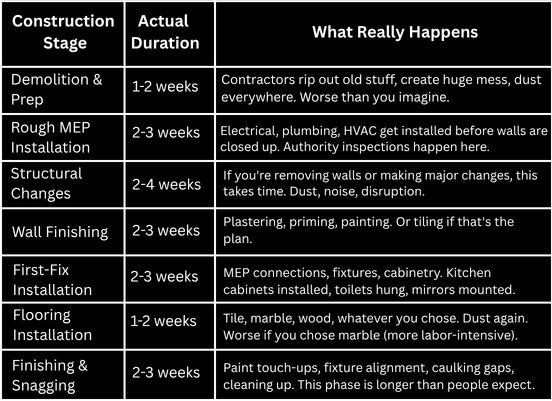
Real Talk: The final 2-3 weeks of “finishing” is where most projects lose momentum. Contractors get tired, move to the next job, and your paint touch-ups get pushed to “next week.” This phase is critical and often gets rushed.
Phase #3: Authority Final Inspection and Handover (1-2 Weeks)
This is the final stretch. You’re almost there, but not quite.
Authority Final Inspection (1-3 days)
- Dubai Municipality (or Trakhees, DDA, etc.) sends an inspector to verify the work matches the approved plans
- Inspector looks for code violations, safety issues, and deviations from approved design
- Most projects pass. Some don’t on the first try.
- If inspector finds issues, you’re on hold until they’re fixed
Defect Correction (3-7 days)
- Contractor fixes anything the inspector flagged
- May require re-inspection
- If changes to approved design were made, might require new authority approval (worst case)
Building Completion Certificate (BCC) Issuance (3-7 days)
- Final permit issued
- You can now legally occupy the space
- Without this certificate, you technically cannot live in the renovated space (and title deed issues arise)
Homeowner Handover (1-3 days)
- Final walkthrough with contractor
- You sign off on completion
- Contractor hands you all documentation, warranty paperwork, instruction manuals for appliances, etc.
- Keys and access transferred
- Project officially complete
Total Timeline: 12-28 Weeks (3-7 Months)
Here’s the honest breakdown for a typical villa renovation in Dubai:
- Best Case (simple project, swift approvals): 3 months
- Authority approvals move fast (3-4 weeks)
- No surprises during construction
- Contractor is efficient and focused
- You find this rarely happens
- Typical Case (standard renovation, normal approvals): 4-5 months
- Authority approvals take expected time (4-5 weeks)
- One or two minor surprises discovered during work
- Contractor balances your project with other projects
- This is what you should plan for
- Complex Case (structural changes, authority delays): 6-7 months
- Structural changes requiring engineer reports (add 3-4 weeks)
- Authority approvals delayed or rejections requiring resubmission (add 2-4 weeks)
- Material lead times impact schedule (40-60 day waits for imported finishes)
- Multiple surprises requiring problem-solving and time
- This happens more than you’d think with older villas
The Timeline Red Flags You Should Ignore
Red Flag: “We can do a full villa renovation in 8-10 weeks”
If your contractor promises this:
- They’re either not planning to get permits (illegal)
- They’re cutting enormous corners on quality
- They’re underbidding and planning to recover through variation orders
- They’re inexperienced
An 8-10 week promise might be accurate if all they’re doing is paint and new flooring. But a genuine villa renovation with MEP work and structural changes? That’s not happening in 8 weeks, not legally anyway.
What Professional Contractors Say: “Authority approvals will take 4-6 weeks. Then construction is typically 10-14 weeks depending on scope and whether we find surprises. So plan for 4-5 months total, with the possibility of extending to 6 months if we encounter structural issues or authority delays.”
Key Question #3: What Preparations Must You Make Before Work Begins?
Preparation #1: Property Access and Logistics
Clear Site Access:
- Ensure parking areas are available for contractor vehicles (not blocking other residents)
- Arrange access to building amenities (elevators, stairwells) if in a tower
- Confirm building management approvals for work hours and site use
- Provide clear access routes for material delivery and waste removal
Temporary Relocation:
- Decide if you will remain in your villa during renovation (often disruptive) or temporarily relocate
- If relocating, arrange accommodation 2-4 weeks before work begins
- Coordinate move-out timing with contractor’s mobilization schedule
Utility Coordination:
- Ensure water supply will remain operational during plumbing work
- Confirm electrical supply is available for tools and work (contractor typically provides generators if main supply must be cut)
- Schedule DEWA notifications if main electrical distribution requires work
Preparation #2: Design Finalization and Material Selection
Finalize All Design Decisions:
- Select all materials (paint, tile, flooring, cabinetry) before work begins
- Make final fixture and finish selections (this should be 100% complete before construction starts)
- Avoid changing decisions mid-project (changes delay the project and increase costs)
Material Ordering and Lead Times:
- Identify any imported materials with long lead times (Italian marble, German cabinetry)
- Order these materials immediately upon contract signing
- Verify delivery dates align with construction schedule
- Arrange storage if materials arrive before installation is ready
Quality Sample Inspection:
- Request samples of all materials before full quantities are purchased
- Verify samples match your expectations in your villa’s lighting (samples look different in showrooms vs. your home)
- Approve samples in writing before production begins
Preparation #3: Documentation and Legal Readiness
Gather Property Documentation:
- Locate your villa’s title deed and property registration
- Obtain building plans or floor plans from the developer (helpful for contractor understanding of structure)
- Collect any previous renovation records if renovations were completed by prior owners
- Verify ownership and clear title status
Confirm Authority Access:
- Your contractor will need to access your property digitally in Dubai Municipality or community authority systems
- Provide any passwords or access codes needed
- Authorize contractor to handle government correspondence on your behalf (through written authorization)
Prepare the Contract:
- Have all contract language reviewed (at minimum, review with the contractor to ensure clarity)
- Ensure all terms are in writing: scope, timeline, payment schedule, warranty, defect liability period
- Do not rely on verbal agreements (they are unenforceable in UAE courts)
- Maintain copies of all contract documents and communications
Preparation #4: Personal Items and Protection
Inventory Valuable Items:
- Remove or secure jewelry, electronics, and valuable items
- Document the property’s pre-renovation condition with photographs
- Note any existing damage so the contractor cannot hold you liable for it
Protect Furniture and Fittings:
- Remove or cover furniture that will remain in the villa during renovation
- Protect installed fixtures (mirrors, lighting, smart home systems) that are not being replaced
- Cover valuable built-ins (bookshelves, artwork) that will be exposed to dust
Establish Site Rules:
- Clarify working hours with your contractor (typically 8 AM – 6 PM, Saturday – Thursday, with no Friday work)
- Set expectations for cleanliness (contractor should maintain reasonable site tidiness)
- Establish rules for parking, waste management, and noise
- Discuss any personal safety or security concerns
Key Question #4: How Do You Stay on Budget During a Renovation?
This is where things get uncomfortable. Most renovation budgets don’t stay on budget. Here’s why, and what you can actually do about it.
Budget Protection Strategy #1: Comprehensive Specification (aka "Write Everything Down")
The biggest budget killer is ambiguity. Your contractor interprets something one way. You interpret it another way. Conflict. Costly changes.
Example of ambiguity that costs money:
- You say: “I want a modern kitchen.”
- Contractor quotes: AED 80,000
- You’re imagining: Custom wood cabinetry, granite countertops, high-end appliances
- Contractor was thinking: IKEA-style cabinetry, laminate counters, builder-grade appliances
That’s a AED 40,000+ difference right there.
How to prevent this: Everything needs to be specified in writing before work starts:
- Material Selection: Specific brand, model, color, and grade. Not just “tile”—”Porcelanosa 60×60 polished marble tile, Calacatta, bulk order from [supplier]”
- Finishes: Specific paint brand and color code, tile dimensions, flooring specifications
- Dimensions: Exact measurements for custom elements (how deep are cabinetry, how tall are counters)
- Quality Standards: How tight should tile joints be? How clean should paint edges be?
When everything is specified, the contractor can’t claim ambiguity. They either execute the specification or they don’t.
Budget Protection Strategy #2: Variation Order Control (aka "No Surprise Changes")
Here’s the most common renovation scam in Dubai: Low initial bid, high variation orders.
How it works:
- Contractor quotes AED 250,000
- Contractor underbid because they knew they’d recover through variation orders
- Week 3 of construction, contractor finds “unexpected” issues
- Suddenly there are AED 50,000 in variation orders
- By project end, you’ve paid AED 300,000+
How professionals handle this:
- Variation orders are priced in writing before work begins (not after discovery)
- Every variation requires justification: Is it a genuine unforeseen condition, or contractor oversight?
- You (the homeowner) have leverage: You can ask for quotes from alternative suppliers
- All variations are documented with your signature before work proceeds
Example of legitimate vs. BS variation orders:
Legitimate: “We discovered outdated plumbing when we opened the wall. It doesn’t meet the current code. We need to replace it. Cost: AED 8,000. Justification: Hidden condition discovered during demolition. Timeline impact: +3 days.” → You review, accept, sign off. The contractor performs work. Payment released with next milestone.
BS: “We need AED 15,000 to upgrade the wiring for your new range. We should have mentioned this during the quote, but we didn’t.” → This is contractor oversight, not an unforeseen condition. You shouldn’t pay extra for contractor mistakes.
Budget Protection Strategy #3: Contingency Reserve Management (aka "Your Emergency Fund")
Your contingency reserve (10-15% of the project cost) is not “padding for profit.” It’s your financial protection against things that go wrong.
Here’s the reality: You budget AED 300,000. That includes AED 30,000 contingency (10%). Then:
- Contractor finds black mold in the wall: AED 5,000
- Plumbing doesn’t meet code: AED 8,000
- Structural issue discovered: AED 10,000
- Your contingency is gone. Now what?
How professionals manage contingency:
- Only for genuine unforeseen conditions – not for contractor mistakes or oversights
- Document every use – write down what the contingency was spent on and why
- Control variation scope – if a variation exceeds remaining contingency, you have options:
- Descope another area (remove something planned)
- Increase overall budget
- Ask contractor to absorb some cost
- Preserve buffer – try to keep 5% contingency until project completion (for final punch-list items)
The contingency is NOT “spend it all or lose it.” If you finish under budget, that money stays in your pocket.
What Wahat Babil Provides in the Planning Phase
At Wahat Babil, we invest heavily in the planning phase because we understand that thorough upfront planning prevents problems later:
Pre-Construction Planning Services
Comprehensive Site Survey and Analysis
- Detailed assessment of existing conditions (structural, MEP, finishes)
- Identification of potential challenges and hidden cost risks
- Recommendations for addressing issues before they become expensive
- Written report with photographs and detailed observations
Budget Development and Breakdown
- Itemized cost estimates with material specifications
- Labor cost estimates based on Dubai market rates
- Authority fees and professional fees included
- Contingency allocation with justification
- Clear explanation of what is and is not included in the budget
Realistic Timeline Development
- Phase-by-phase schedule including authority approval periods
- Identification of critical path items (materials with long lead times)
- Contingency scheduling for potential delays
- Clear statement of assumptions (e.g., “Authority approval assumed to take 4 weeks”)
Material Specification and Sourcing
- Assistance with design finalization and material selection
- Recommendations for quality levels based on your budget
- Sourcing of materials with verification of availability and lead times
- Sample procurement and quality verification
Authority Management Strategy
- Identification of required permits and approvals
- CAD drawing preparation for authority submission
- Authority application support and liaison
- Inspection scheduling and coordination
Design Consultation
- Professional design input from our in-house design team
- Recommendations for layouts, finishes, and functionality improvements
- Compatibility assessment of your design preferences with your villa’s structure and utilities
Conclusion: Your Planning Checklist
Before your renovation begins, verify these planning essentials:
✓ Realistic Budget: Includes contingency reserve (10-15%) and accounts for hidden costs
✓ Realistic Timeline: Includes 3-6 weeks for authority approvals before construction begins
✓ Design Finalization: All design decisions, material selections, and specifications completed before work begins
✓ Authority Approvals: Contractor has confirmed which authority governs your property and is responsible for permit processing
✓ Material Sourcing: Long-lead-time materials identified and ordered upon contract signing
✓ Site Preparation: Property access, logistics, and temporary relocation plans finalized
✓ Contract Clarity: All scope, timeline, cost, and payment terms documented in writing
✓ Variation Order Process: Clear procedure for handling unforeseen conditions and approved changes
✓ Contingency Management: Reserve funds allocated and rules established for contingency spending
✓ Documentation: Property records, design documents, and all contract communications maintained
A well-planned renovation is not necessarily a perfect renovation, but it is a controlled renovation. You proceed with realistic expectations, clear understanding of costs and timelines, and a contractor who is aligned with your goals and priorities.
The investment in planning upfront—working with a professional contractor to develop detailed budgets, realistic timelines, and comprehensive specifications—pays enormous dividends in reduced stress, fewer surprises, and a finished product that meets or exceeds your expectations.