


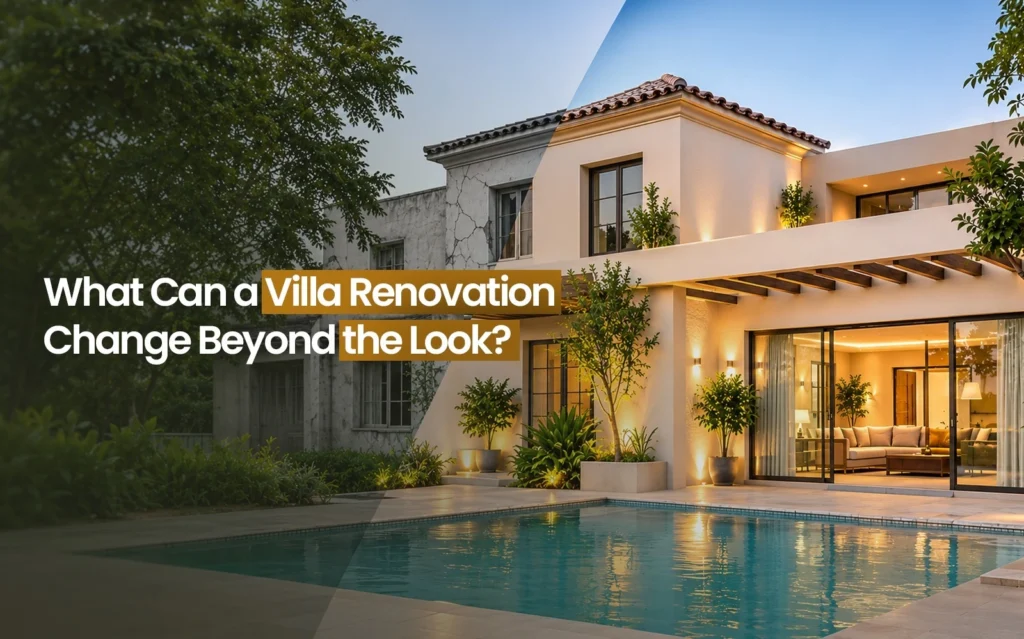
Most people picture a renovation as a change of surface: new tiles, a new kitchen, a fresh coat of paint. Those matter. But the most satisfying results often come from what you cannot see in a photograph: a house that stays comfortable in August, carries the loads you actually use, and keeps water where it belongs.
The good news is that a renovation is the moment to make those changes, because the walls are already open. This guide looks at six upgrades a villa project can deliver, drawing on three documented Wahat Babil projects. If you are weighing a renovation company in Dubai, these are useful things to ask about, because they separate a refresh from a renewal.
A note on evidence: the project details below are self-reported from the company’s case studies, and no performance figures such as energy savings were published for them, so none are claimed.
1. A Layout That Fits How You Live
What it means: moving or removing walls and columns so rooms work for your household.
Layout is the upgrade people notice first. At Meadows 5 Villa 30, the owners gained space on three sides, and the published account says steel framing took over from ground-floor concrete columns to open up the plan. Springs 1 Villa 28 added a structural living room extension, and Deema Villa 89 combined an extension with a wider renovation.
The encouraging part: structure is more adaptable than many owners expect, provided an engineer assesses it first. Our article on structural work in a Dubai villa explains how this is done, and the structural villa extension service page sets out the scope.
2. Cooling Designed for the Whole House
What it means: replacing patchwork air conditioning with a planned system.
Two of the documented projects installed VRF HVAC. A VRF system links a number of indoor units to shared outdoor equipment and lets different rooms be set separately. On Springs 1 Villa 28, HVAC was treated as its own work zone, coordinated with the electrical and structural teams, and commissioned only after the spaces were complete.
The encouraging part: a renovation lets cooling be planned together with ceilings, ducting routes and power, instead of being squeezed in afterwards. See our AC services page and the MEP services page for the scope.
3. Electrical Capacity for Modern Life
What it means: wiring and boards able to carry the appliances, lighting and charging you use now.
Springs 1 Villa 28 and Deema Villa 89 both include full rewiring in their descriptions, and a dedicated electrical upgrade zone. Capacity is often the quiet limit on what a home can add. Read why the distribution board decides what you can add, and what EV charger installation involves for a villa.
The encouraging part: upgrading the supply once, while ceilings and walls are open, is simpler than adding circuits piece by piece later.
4. Water Kept Where It Belongs
What it means: waterproofing that is designed, applied and tested rather than assumed.
That same Meadows project reports a 24-hour flood test of its bathroom tanking before tiling work relied on it. For structural elements exposed to water, Article 55 of Administrative Resolution No. 37 of 2021 calls for a full waterproof tanking system. That is the code’s text on new work, and a useful standard to ask about for your own.
The encouraging part: water problems are among the most costly to find late and the easiest to prevent early. See villa waterproofing in Dubai.
5. Bathrooms and Kitchens That Work Harder
What it means: rebuilding wet rooms and cooking spaces with the systems behind them.
All three documented projects include rebuilt bathrooms, and the case studies describe humidity-resistant substrates and vapour barriers in wet areas. A full kitchen remodel brings plumbing, ventilation, power and storage into one plan; our guide to the kitchen remodel walks through it. The kitchen and bathroom service pages describe the scopes.
The encouraging part: these rooms transform daily routines more than any other, and a well-planned remodel solves the hidden problems at the same time.
6. A Home With Its Paperwork in Order
What it means: finishing with a file that proves what was done.
This is the upgrade nobody photographs, and the one owners are glad of years later. A good handover includes permits, no-objection certificates, as-built drawings, test certificates, material specifications and a written warranty. Springs 1 Villa 28 lists structural inspections, waterproofing tests, electrical testing and HVAC commissioning among its quality checks.
The file matters more now. Dubai Law No. (3) of 2026 introduces a Quality and Safety Certificate for buildings 20 years past their Completion Certificate, supported by an engineering report on structure, installations and openings. A villa with good records and recent upgrades is better placed for that day. See buying an older villa and the 20-year safety rule and handover and snagging.
The encouraging part: documentation costs little to gather at handover and a great deal to rebuild later.
Putting the Six Together
| Upgrade | What you gain | Documented example |
|---|---|---|
| Layout | Rooms that suit your household | Meadows 5 Villa 30 |
| Cooling | Planned, zoned comfort | Springs 1 Villa 28 |
| Electrical | Capacity for current and future use | Springs 1 Villa 28 and Deema Villa 89 |
| Waterproofing | Tested protection | Meadows 5 Villa 30 |
| Kitchens and bathrooms | Better daily routines | All three projects |
| Records | Evidence and readiness | Springs 1 Villa 28 |
Cost is not shown because no reliable published figure for these upgrades was found. Ask for itemised quotes so each upgrade is priced on its own, using our quote guide.
Where to Start
Choose one or two upgrades to put first, and let the rest follow in later phases. A renovation does not have to do everything at once to be worthwhile; it has to be sequenced so that early work does not block later work, and so that each stage leaves the home in better condition than it found it. If your villa is older, begin with the assessment, then plan electrical, cooling and water protection before finishes. Our overview of every type of home renovation helps you sort the options, and the home and villa renovation service page shows the full scope. See completed work on the projects page, or contact the team to discuss your villa.
Frequently Asked Questions
Is a villa renovation only about appearance? No. It can also change layout, cooling, electrical capacity, water protection and the paperwork you hold.
Which upgrade should come first? Faults and hidden systems first, then layout, then finishes.
Do these upgrades need approvals? Some do. Structural and electrical changes typically need permits or a DEWA no-objection certificate, so confirm the route for your community.
Can the upgrades be done in stages? Yes. Hidden systems are best done together while walls are open, but finishes and some rooms can follow later.
Project details come from Wahat Babil’s published case studies and are self-reported. Code and law references are summarised from the cited sources as of November 2026. This is general information, not legal or engineering advice.