


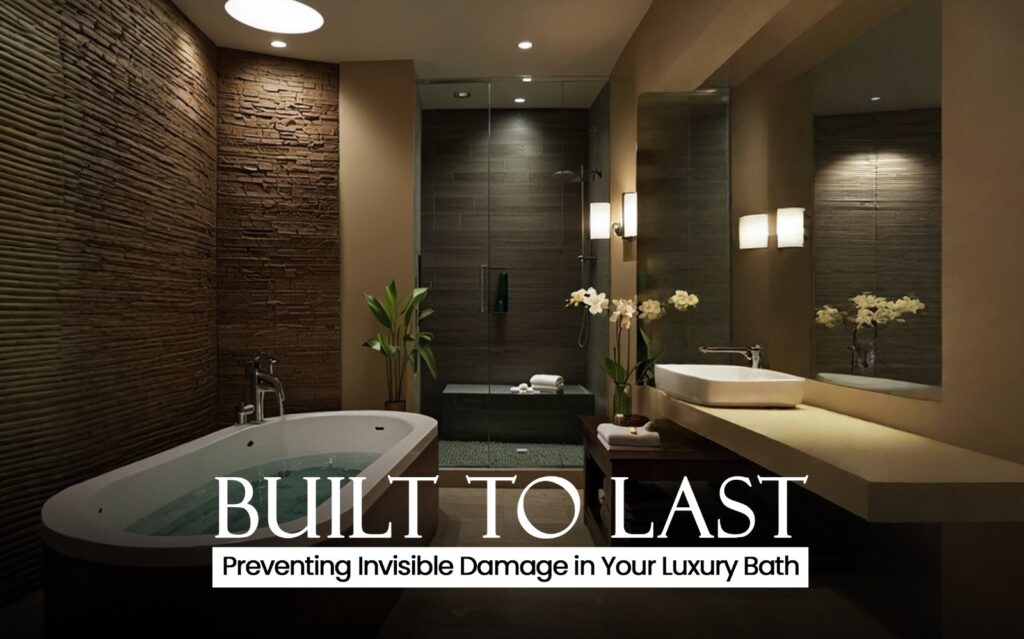
In Dubai’s luxury residential sector, the bathroom represents far more than a functional necessity—it is a complex hydrothermal system operating under some of the world’s most challenging environmental conditions. The stark reality facing villa and apartment owners across Jumeirah, Dubai Marina, and Palm Jumeirah is that invisible damage—structural degradation, interstitial condensation, and sub-surface moisture ingress—frequently remains undetected until remedial costs escalate to AED 50,000-200,000 or more.
The difference between a bathroom that functions flawlessly for decades and one that becomes a financial liability within years lies not in the visible finishes, but in the engineering precision applied to systems you cannot see. Understanding these invisible threats and implementing world-class prevention strategies is the foundation of truly lasting luxury.
The Unique Challenge: Dubai's Hostile Bathroom Environment
Dubai’s climate creates a perfect storm of conditions that accelerate bathroom degradation. Extreme outdoor heat exceeding 45°C, aggressive indoor air conditioning maintaining 22-24°C interiors, ambient humidity reaching 60-90% during summer months, and salt-laden coastal air combine to create an environment where standard construction practices fail catastrophically.
The three primary mechanisms of invisible damage are:
1. Interstitial Condensation and Thermal Bridging
The extreme temperature differential between scorching exteriors and aggressively cooled interiors creates condensation within wall cavities—a phenomenon called interstitial condensation. Thermal bridging occurs at junctions where insulation is discontinuous: slab edges, concrete columns meeting cavity walls, and window perimeters.
When surface temperatures drop below the dew point, water vapor condenses into liquid water inside your walls. Thermal imaging studies of luxury Jumeirah villas detected anomalies in 72% of wall-floor junctions where surface temperatures were 4.2-7.8°C below ambient, creating hidden moisture accumulation. This trapped moisture facilitates mold and mildew growth behind high-end finishes like gypsum board or wood paneling—degrading indoor air quality and creating respiratory health risks even when no visible damage appears on surfaces.
The structural foundation for prevention:
Dubai Municipality Building Code (DMBC) Article 55 specifies maximum allowable deflection values to prevent micro-fractures that compromise waterproofing. After installation of joints for slabs and beams, deflection must not exceed L/480 or 20mm (whichever is lower). This stringent limit ensures that rigid luxury materials—large-format marble, porcelain slabs—don’t experience stress-induced cracking that would breach underlying waterproofing membranes.
For post-tensioned slabs ubiquitous in Dubai’s luxury towers, the code mandates minimum 200mm thickness using Dubai Central Laboratory certified tensile strands with 1860 MPa nominal tensile strength. These structural parameters mitigate vibrations and shortening effects that cause “ghost leaks” in plumbing connections.
2. Capillary Action Through Grout Lines
A critical misconception is that tile grout provides waterproofing. Standard cementitious grout is porous and absorbs moisture through capillary action—microscopic channels that wick water behind tiles, especially in high-use shower areas. Over time, this moisture accumulates behind expensive finishes, causing paint to bubble on opposite walls or—in apartments—catastrophic leaks to units below.
The solution lies in material specification:
Epoxy grouts from manufacturers like Mapei, Kerakoll, and Laticrete offer 100% solids formulation that is virtually waterproof, preventing moisture from reaching substrates. Products like Mapei’s Kerapoxy Easy Design provide bacteriostatic properties resisting mold and mildew growth—critical in Dubai’s humid climate. While epoxy grout costs 2-3x more than cementitious alternatives and requires skilled application, its long-term maintenance requirements are minimal, delivering substantial lifecycle savings.
3. Saline Corrosion of Hidden Fixtures
For coastal properties in JBR, Dubai Marina, and Palm Jumeirah, salt-laden marine air poses relentless threats to plumbing infrastructure. Sodium chloride particles settle on metal pipes and fixtures, combining with atmospheric moisture to create highly corrosive electrolyte solutions. This accelerates metal deterioration by 5-10x compared to inland areas, affecting the components you cannot see: pipe connectors, anchors, and brackets concealed behind walls.
Pitting corrosion eats through metal pipe walls creating pinhole leaks impossible to detect without specialized acoustic or thermal equipment. By the time visible water damage appears, extensive hidden deterioration has already occurred.
World-Class Waterproofing: The Foundation of Durability
Preventing invisible damage demands high-performance tanking systems creating seamless, impermeable barriers. System selection depends on geometry, substrate condition, and expected usage patterns.
Liquid-Applied Polyurethane (PU) Membranes
Liquid PU membranes represent the gold standard for complex luxury bathroom geometries. Applied in multiple coats, these membranes cure to form highly elastic, jointless skins that bridge minor structural cracks.
The rigorous application protocol includes:
- Substrate preparation: Thorough cleaning removing dust, oil, and grease, with crack repair completed before application
- Priming: Enhancing adhesion with 4-6 hour cure time
- First coat application: Liquid membrane (polyurethane or acrylic-based) applied via rollers or airless spray to 1.0-1.2mm wet film thickness
- Reinforcement: Fiberglass mesh embedded at internal corners, pipe penetrations, and construction joints while first coat remains wet
- Second coat: Applied perpendicular to first ensuring even coverage, achieving minimum 1.5mm total dry film thickness (DFT)
- Curing and testing: 24-48 hour cure protected from foot traffic, followed by water ponding test retaining 25mm of water for 24 hours verifying integrity
GRP (Glass Reinforced Plastic) Lining for Sunken Slabs
Luxury villas frequently utilize sunken slabs enabling walk-in showers, concealed drainage, and wall-hung toilets. These areas require heavy-duty protection due to potential stagnant water accumulation. GRP lining—consisting of fiberglass-reinforced resin barrier—provides superior resistance to both water and chemical attack.
GRP is virtually impervious and represents the preferred method for first-floor bathrooms in high-end developments, preventing catastrophic leaks to floors below. This system is particularly effective for lining leaking underground water tanks with tiled interiors, offering durable solutions lasting up to 25 years with proper installation.
Performance comparison of waterproofing systems:
- PU Liquid Membrane: Ideal for complex geometries and showers, offering seamless crack-bridging with 5-10 year warranties
- GRP Lining: Best for sunken slabs and water tanks, providing high chemical/water resistance with 10-25 year warranties
- Cementitious Slurry: Standard under-tile applications, strong concrete bonding with 3-5 year warranties
- Bituminous Coating: Below-grade and foundations, highly durable for footings with 10 year warranties
Precision Plumbing: Materials That Withstand Dubai's Extremes
Piping material selection must withstand high pressure, mineral-rich water, and thermal stresses unique to the UAE environment. Wrong choices accelerate failure.
High-Performance Piping Materials
Stainless Steel: Represents the pinnacle of durability and hygiene, increasingly popular for luxury high-rises due to exceptional high-pressure resistance and natural ability to resist aggressive water quality. Antimicrobial properties maintain water purity.
PEX (Cross-Linked Polyethylene): Flexibility allows continuous runs from manifold to fixture, dramatically reducing hidden joints behind walls—each representing a potential failure point. Resistant to scale and chlorine, withstands freezing without bursting.
Copper: Naturally antimicrobial and durable, still used in high-end builds. Requires highly skilled soldering ensuring joints don’t fail under thermal expansion. More expensive but proven longevity.
PPR (Polypropylene Random Copolymer): Heat-resistant with leak-proof fusion-welded joints. Popular for cost-effectiveness while maintaining quality standards.
Pressure Testing and Quality Assurance
Before bathroom finishes are applied, entire plumbing systems must undergo rigorous pressure testing. Pipes are filled with water or air at pressures significantly exceeding standard operating levels to expose even pinhole-sized leaks. This phase represents the ultimate quality checkpoint in “built to last” philosophy.
DEWA requires No Objection Certificates (NOC) for major plumbing works, ensuring designs meet local codes before construction commences. For wet areas located above electrical service rooms, regulations are stricter: reinforced concrete attic slabs must be provided with entire slab including vertical sides waterproofed by approved systems. All pipes and joints must be wrapped with approved waterproofing membranes.
HVAC and Indoor Air Quality: The Invisible Protector
Bathroom HVAC systems are as critical to longevity as waterproofing. Poor ventilation traps steam and moisture, degrading paint, warping cabinetry, and enabling toxic mold growth in hidden ceiling voids.
Al Sa’fat Green Building Requirements
The Al Sa’fat system mandates mechanically ventilated air-conditioned buildings ensuring adequate indoor air quality through:
- Minimum ventilation: Compliance with ASHRAE Standards 62.1 and 62.2, providing at least six outside air changes per hour
- Negative pressure: Dedicated extraction creating negative pressure preventing hazardous fumes, odors, and moisture migration into adjacent living areas
- Energy recovery: Systems handling at least 50% of total exhausted air with minimum 70% sensible load recovery efficiency
Advanced Humidity Control
Luxury bathroom designs increasingly integrate smart HVAC controls with CO2 sensors and thermostats modulating fan speeds via Variable Frequency Drives (VFDs). Advanced systems include whole-home dehumidifiers targeting healthy relative humidity ranges of 45-55%, reducing moisture levels by up to 85% and eliminating musty odors that indicate hidden mold growth.
Diagnostic Technologies: Seeing the Invisible
Modern luxury maintenance utilizes advanced technology identifying what human eyes cannot detect, enabling early intervention preventing extensive damage.
Infrared Thermography and Moisture Mapping
Infrared cameras like the FLIR T865 translate invisible thermal anomalies into actionable data. Wet materials retain heat differently than dry materials, making moisture intrusion appear as thermal signatures—cool spots during day scans or warm spots during evening scans.
Comprehensive assessments of Jumeirah villas demonstrate that infrared thermography achieves 92% sensitivity detecting hidden moisture at junctions, compared to only 68% for pinless moisture meters alone. This non-invasive method identifies leaks behind marble cladding or under floors without destructive testing.
Smart Leak Detection and IoT Monitoring
Integration of smart technology enables 24/7 bathroom integrity monitoring:
- Wireless leak sensors: LoRaWAN devices placed below raised floors or near pipe penetrations providing real-time alerts when moisture is detected
- Acoustic and tracer gas systems: For deep-seated leaks in pressurized lines, enabling technicians to pinpoint exact sources without drilling walls or removing expensive tiles
- Centralized monitoring: Integration into Building Management Systems (BMS) centralizing temperature, humidity, and leak monitoring across luxury developments
Wahat Babil: Your Partner for Bathrooms Built to Last
Delivering genuinely durable luxury bathrooms demands more than purchasing premium materials—it requires engineering expertise integrating waterproofing, plumbing, HVAC, and diagnostic technologies into unified, resilient systems. This is precisely the capability Wahat Babil has perfected since 2006.
With 18 years of Dubai-specific experience, over 75 completed villa transformations, and full electromechanical licensing, Wahat Babil approaches every bathroom as a sophisticated hydrothermal system requiring precision engineering rather than cosmetic finishing.
Wahat Babil's comprehensive bathroom renovation services include:
Advanced Waterproofing Systems:
Complete application of liquid-applied PU membranes with proper substrate preparation, reinforcement mesh at all critical junctions, and GRP lining for sunken slabs and walk-in showers. Rigorous water ponding tests verify integrity before finish application.
Precision Plumbing Engineering
High-performance material specification including stainless steel and PEX for coastal properties, complete pressure testing protocols exceeding DEWA standards, and strategic placement minimizing hidden joints that represent failure points.
MEP Integration
Complete mechanical, electrical, and plumbing coordination ensuring HVAC systems provide both cooling and critical dehumidification. Compliance with Al Sa’fat IAQ requirements and ASHRAE ventilation standards. Smart humidity control integration maintaining optimal 45-55% relative humidity ranges.
Premium Material Specification
Antimicrobial epoxy grout application blocking capillary moisture pathways, natural stone sealing and protection protocols for marble and granite surfaces, and marine-grade specifications for coastal villa bathrooms resistant to saline corrosion.
Diagnostic Assessment
Pre-renovation thermal imaging identifying existing moisture intrusion and thermal bridging, moisture mapping quantifying hidden water accumulation, and post-renovation verification ensuring all systems function as engineered.
Complete Bathroom Renovation
Structural assessment verifying deflection limits per DMBC Article 55, proper vapor barrier installation preventing interstitial condensation, humidity-resistant materials selected for Dubai’s extreme climate, and ventilation sizing engineered for moisture management.
What distinguishes Wahat Babil is single-point accountability. Where conventional renovations fragment responsibility across multiple subcontractors—creating coordination gaps producing waterproofing failures, mismatched systems, and compromised performance—Wahat Babil’s integrated team manages every discipline under unified engineering oversight. The project manager coordinating your waterproofing also oversees plumbing installation and HVAC integration. Nothing falls through the cracks.
Their methodology begins with comprehensive diagnostics: thermal imaging, moisture assessment, structural evaluation, and HVAC performance audits. This data-driven foundation ensures every intervention is technically justified and engineered for measurable, long-term performance rather than temporary cosmetic appeal.
The Investment in Invisibility
The systems protecting your luxury bathroom from invisible damage—the waterproofing membranes, the precision plumbing, the engineered ventilation—represent the most important investment you’ll make. These are the components determining whether your bathroom provides decades of flawless service or becomes a source of ongoing maintenance headaches and catastrophic repair bills.
If you’re planning a bathroom renovation or experiencing signs of hidden moisture problems—musty odors, unexplained humidity, temperature anomalies—Wahat Babil is ready to engineer the solution.
Contact Wahat Babil today for a comprehensive bathroom assessment. Let Dubai’s engineering-first renovation partner build you a luxury bathroom engineered to last—protected by precision, proven by performance, guaranteed for life.