


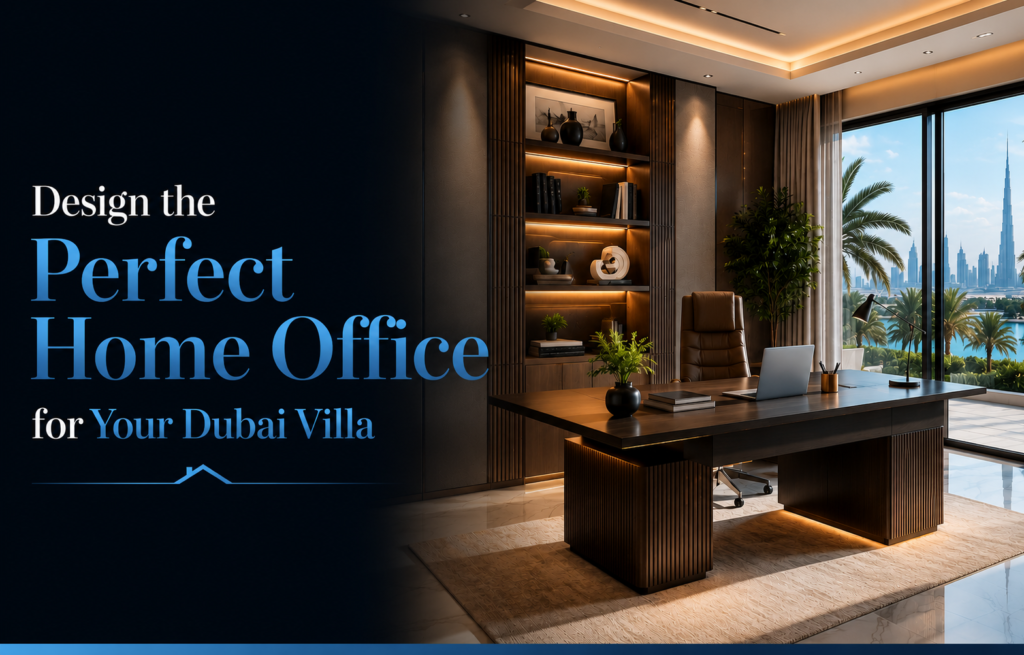
Working from home has become the norm for many Dubai professionals. Whether you’re a business owner running international operations from your villa or an executive joining video conferences from your home office, your workspace needs to be professional, comfortable, and distraction-free. Creating an effective home office in Dubai isn’t just about selecting a desk and adding a chair, it requires careful planning around sound control, lighting, climate management, and smart automation.
This guide explains the essential elements that transform an ordinary room into a high-performance home office suited to Dubai’s unique climate and lifestyle demands.
Why Home Office Design Matters in Dubai
Dubai’s luxury villas often feature open floor plans with marble floors, glass walls, and high ceilings. While beautiful, these design elements create challenges for home offices:
- Hard surfaces reflect sound, making video calls difficult
- Intense Dubai sunlight causes glare on screens
- Extreme heat and humidity require sophisticated climate control
- Coastal salt air and dust damage standard materials quickly
A well-designed home office overcomes these challenges, creating a space where you can work productively without compromising your villa’s aesthetic.
Element 1: Sound Control (Acoustic Privacy)
Why Acoustics Matter
Imagine joining an important client call and hearing every conversation from the living room, kitchen, or neighboring room. Poor sound isolation destroys professionalism. Additionally, working in a space with excessive echo and reverberation causes listening fatigue and headaches.
How Sound Travels
Sound travels through walls via vibrations. When someone speaks in the adjacent room, sound waves hit the wall, vibrate the wall structure, and transmit through to your office. Standard drywall provides minimal sound isolation. Professional offices require specialized construction.
Key Acoustic Solutions
Wall Isolation:
Professional home offices use double-layer drywall with special damping compounds between sheets. This creates a barrier that absorbs sound vibrations rather than transmitting them. The standard target is an STC (Sound Transmission Class) rating of 50 or higher meaning loud conversations in adjacent rooms sound like faint murmurs.
Ceiling Acoustics:
Hard surfaces like marble and drywall reflect sound, creating echo and reverberation. Professional offices install specialized acoustic plaster systems, thin, plaster-like finishes that absorb sound while maintaining the aesthetic of “quiet luxury” design. These microporous finishes trap sound waves, eliminating unwanted echo.
Window Glazing:
Floor-to-ceiling glass windows look beautiful but transmit sound easily. High-performance acoustic glazing uses laminated glass with special sound-damping layers that reduce external noise (street traffic, construction) and internal noise transmission significantly.
Result: A properly acoustically designed office maintains privacy, reduces background noise to imperceptible levels, and allows clear video communication.
Element 2: Lighting for Productivity and Wellness
The Challenge with Dubai's Natural Light
Dubai’s intense sunlight creates two problems: excessive glare that causes eye strain, and heat gain that overwhelms air conditioning. Additionally, artificial lighting must support both productivity and human biology.
Professional Lighting Standards
A productive workspace requires approximately 500 lux (brightness level) on your desk enough for detailed work without causing eye strain. The light should have high color rendering (CRI 90+), meaning colors appear natural and true.
The Circadian Rhythm Connection
Your body has an internal clock influenced by light. Blue-toned light (like morning sunlight) tells your body to be alert. Warm, amber light (like sunset) signals your body to prepare for sleep.
Professional home offices use smart lighting systems that:
- Provide cool, bright light (5000K color temperature) during working hours to maintain focus and alertness
- Shift to warm, dim light (2700K or lower) in the evening to support relaxation
- Include motorized shades to control glare and heat gain throughout the day
Result: Better focus during work hours, reduced eye strain, and improved sleep quality at night.
Element 3: Climate Control (Temperature & Humidity)
Dubai's Humidity Challenge
Dubai’s coastal climate brings humidity levels exceeding 90% in early mornings. When warm, humid outdoor air enters your air-conditioned office, it condenses on cold surfaces marble floors, walls, windows creating moisture problems.
Sustained humidity above 60% encourages mold growth within 24-48 hours, particularly in corners and behind furniture. This damages your villa’s materials and creates health risks.
The Solution: Balanced Climate Management
Humidity Control:
Professional home offices maintain relative humidity between 40-55% the comfort zone that prevents both mold growth and dry-air respiratory discomfort. This requires:
- Regular air conditioning maintenance (dirty coils reduce cooling efficiency)
- Energy Recovery Ventilators (ERVs) that pre-cool and dehumidify fresh outdoor air before it enters your office
- Proper thermostat settings: maintain temperatures at 22-24°C with fans set to “Auto” (not “On”)
Air Quality:
Your workspace needs continuous fresh, filtered air to remove carbon dioxide and volatile organic compounds (VOCs) that accumulate during work. However, introducing raw outdoor air directly overwhelms cooling systems. ERV systems solve this by exchanging heat and moisture between incoming outdoor air and outgoing exhaust air, reducing the cooling load by up to 80%.
HVAC Noise Control:
Air conditioning noise becomes obvious in a quiet office. Professional systems:
- Size ductwork carefully to prevent air velocity from creating noise
- Use flexible connections to prevent vibration transmission
- Install sound attenuators (silencers) in duct runs
- Mount equipment on vibration-isolating springs
Result: A comfortable office maintaining ideal temperature and humidity while operating quietly.
Element 4: Smart Automation & Integration
Modern home offices integrate acoustics, lighting, and climate control into unified smart systems. This allows one-touch scene activation:
“Video Conference” Scene: Automatically dims lights to reduce glare on your screen, lowers motorized shades to minimize outside distractions, and reduces HVAC fan speed to eliminate background noise during calls.
“Deep Work” Scene: Provides maximum task lighting, closes shades for privacy, and optimizes temperature for concentration.
“End of Day” Scene: Switches lighting to warm tones, opens shades to support natural wind-down, and gradually adjusts climate to evening comfort settings.
These systems use industry-standard protocols (KNX, Lutron HomeWorks) that allow different manufacturers’ products to communicate seamlessly. Your lighting, shading, climate control, and room sensors all work together automatically.
Key Attributes for Successful Home Office Integration
When planning your home office renovation, prioritize these attributes:
✓ Acoustic Privacy – STC 50+ wall construction, specialized ceiling finishes, acoustic glazing
✓ Light Quality – 500 lux task lighting, high color rendering, circadian-responsive systems
✓ Climate Comfort – 40-55% humidity control, ERV ventilation, quiet HVAC operation
✓ Visual Comfort – Motorized glare control, balanced brightness ratios
✓ Air Quality – Fresh air supply, filtration, VOC removal
✓ Smart Integration – Unified control of all building systems
✓ Regulatory Compliance – Al Sa’fat 2.0 Dubai green building standards
✓ Material Durability – Climate-appropriate finishes withstanding Dubai’s extreme conditions
How Wahat Babil Creates Professional Home Offices
At Wahat Babil, we specialize in home office designs that balance professional functionality with luxury villa aesthetics. Our approach includes:
Expert Assessment: We evaluate your villa’s existing conditions, wall construction, natural light patterns, HVAC systems to identify specific opportunities and challenges.
Dubai-Specific Design: Our team understands Dubai’s climate demands and building regulations (Al Sa’fat 2.0 compliance). We specify materials and systems proven to perform in desert conditions.
Integrated Solutions: We coordinate acoustics, lighting, climate control, and automation into cohesive systems. Rather than treating these as separate components, we design them to work together.
Professional Execution: From acoustic wall construction to ERV ventilation installation to smart system programming, our team executes with precision. Acoustic performance, lighting quality, and climate comfort depend on proper installation not just good design.
Timeline Transparency: Home office renovation requires proper authority approvals, material sourcing, and quality execution. We provide realistic timelines accounting for Dubai’s permitting process and specialized component lead times.
Post-Completion Support: Smart home systems require programming and optimization. We don’t hand over a complex automated system without ensuring you understand operation and comfort targets have been met.
Conclusion
Creating a professional home office in your Dubai villa requires specialized expertise in acoustics, lighting, climate control, and automation areas where generic contractors lack experience. The difference between an ordinary home office and an exceptional one is the difference between tolerating your workspace and thriving in it.
Your home office should support focus, enable professional communication, and maintain your well-being during long work hours. When designed correctly, it becomes not just a productive workspace, but a sanctuary within your villa.
Wahat Babil transforms villas into homes that work as well as they live. Contact us to discuss how we can design and execute your professional home office, a space perfectly balanced between functionality and the luxury aesthetic your villa deserves.