


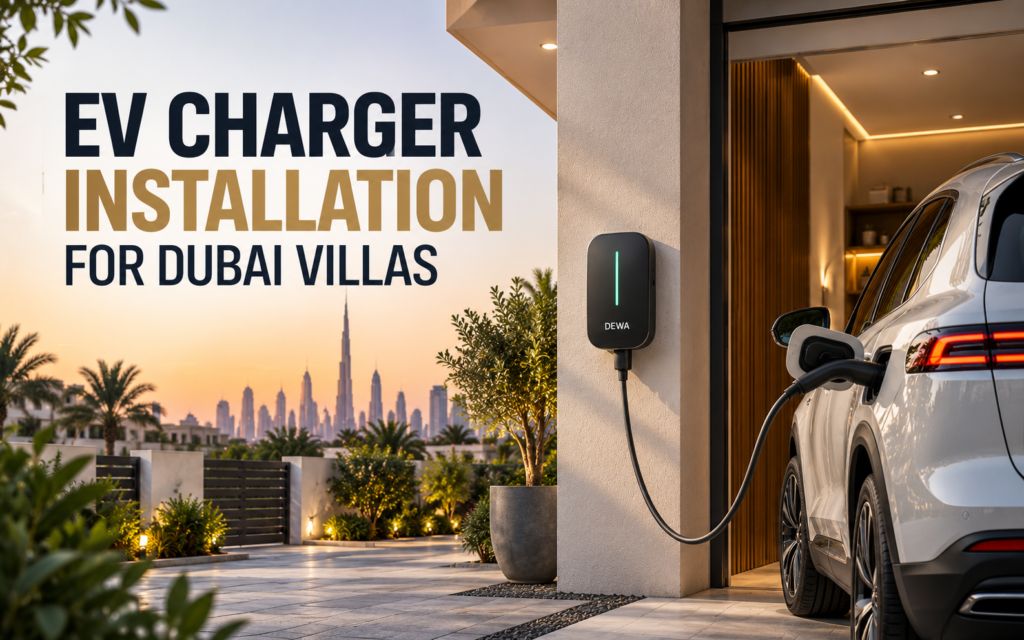
If you are buying an electric vehicle in Dubai and want to charge it at home, the first thing you will notice is that every source online gives you a different number. One guide says Dubai has 400 public charging stations. Another says 740. A third says 1,860. A fourth says 2,223. These are all published in 2026, describing the same city, and none of them agree.
That inconsistency matters less for your own villa than it might seem, because home charging and public charging are two separate systems with different rules. What actually determines whether your installation goes smoothly is DEWA’s home charging framework, your community’s approval requirements, and your villa’s existing electrical capacity, not how many public chargers exist across the city. This guide focuses on the part that is actually confirmed and actionable for a villa owner.
Why DEWA Is Involved in a Private Home Installation
DEWA regulates all electrical installations in Dubai, and a home EV charger is treated as an electrical installation, not a plug-in appliance. In practice this means the work must be carried out by a DEWA-approved electrical contractor, not any general electrician, and the installation is subject to DEWA’s technical standards rather than whatever the charger manufacturer’s manual assumes about a generic household circuit.
Two requirements come up consistently across the installers and guides we reviewed: the charger needs its own dedicated circuit breaker, separate from any other appliance load, and the connector must be a Type 2 (IEC 62196) unit, which matches most EVs currently sold in the UAE including Tesla, BYD, MG and Nissan. If a quote you receive skips either of these, treat it as a sign the installer is not actually following DEWA’s framework, whatever they claim.
Single Phase or Three Phase, and Why It Matters for a Villa
Charger output is limited by the electrical supply feeding it, not just the charger itself. A single-phase supply supports chargers up to roughly 7kW on a 32A circuit, which is the standard setup in most apartments and townhouses. Villas commonly have three-phase supply available, which is what allows the higher-output 11kW (48A) and 22kW (96A) chargers that charge a typical EV significantly faster overnight.
This is the first real cost variable in any villa installation: if your distribution board does not currently have three-phase capacity routed to where you want the charger, the job is not just mounting a unit on a wall, it is a panel and cabling upgrade first. Ask any installer to confirm your villa’s existing phase capacity before quoting a charger speed, not after.
The Community NOC Most Homeowners Don't Expect
Beyond DEWA’s technical approval, many villa communities require a separate no objection certificate from the developer or the owners’ association before installation work begins. This runs in parallel to, not instead of, DEWA’s own process, and it is the step most first-time EV owners are surprised by, because it is easy to assume DEWA’s approval is the only one needed.
This is the same layered-approval pattern we covered in our guide to villa renovation permits in Dubai: a community-level sign-off sitting alongside, and often ahead of, the authority-level one. If your community already has documented rules for structural work or MEP changes, an EV charger installation is likely to fall under the same review process rather than a separate, lighter one.
What DEWA's Green Charger Programme Actually Offers
DEWA runs the Green Charger initiative to support home charging adoption, and multiple sources consistently report a subsidy of AED 10,000 toward villa installation costs, with a lower figure for apartment buildings with multiple EV owners. That figure appears often enough across independent sources that it is reasonably reliable, even though we were not able to verify it directly against DEWA’s own published tariff page during this research. Confirm current eligibility and subsidy status directly with DEWA or your installer before budgeting around it, since incentive programmes are the kind of detail that changes without much notice.
Running costs are more consistently reported: home charging is typically priced around AED 0.29 to 0.44 per kWh, well below public fast-charging rates that run AED 1.20 or higher. Several sources put the payback period for a home charger, relative to relying on public charging, at roughly two to four years, though this depends heavily on how much you actually drive and charge at home versus on the road.
What a Villa Installation Actually Costs
This is where the sourcing gets thin. Quoted installation costs across the installers we reviewed range from roughly AED 2,750 (hardware plus a fixed installation fee from one provider) to AED 4,000 to 8,000 for a full villa setup from another, with the difference driven by cable run length, whether panel upgrades are needed, and charger output. Neither of these figures is an official DEWA price, they are individual installers’ own quoted ranges, and given how much they already vary before accounting for your specific villa’s wiring, we are not going to present a single number as the answer. The only way to get a real figure is a site assessment of your actual distribution board and cable route, which is also the only way to know whether a panel upgrade is hiding inside what looks like a simple installation.
What to Ask Before You Book an Installation
Ask directly whether the contractor is DEWA-approved for electrical work, not just experienced with EV chargers generally. Ask whether your villa’s existing supply is single-phase or three-phase, and whether that limits your charger speed options before any upgrade. Ask whether your community requires a separate NOC, and who is responsible for submitting it. And ask for the quote broken down between hardware, cabling, any panel work, and DEWA coordination, rather than one bundled figure, the same itemisation standard we recommend for any Dubai renovation quote.
Where This Fits Into a Larger Renovation
An EV charger is often the first electrical upgrade a villa owner considers, but it frequently surfaces a wider question: whether the villa’s distribution board and circuit protection can actually support modern loads at all, especially in older properties. This is exactly the kind of assessment that belongs alongside broader MEP work rather than treated as a standalone add-on. Our MEP services team handles electrical capacity assessments, panel upgrades and EV charger installation as part of an integrated scope, rather than as three separate trades reporting to three separate contractors.
If you are planning a villa renovation that includes an EV charger, get the electrical capacity assessed early in the process, not after your kitchen or extension design is finalised, since a panel upgrade can affect where cabling routes and where the charger can actually sit. Get in touch if you want that assessment done as part of a wider project rather than a separate callout.