


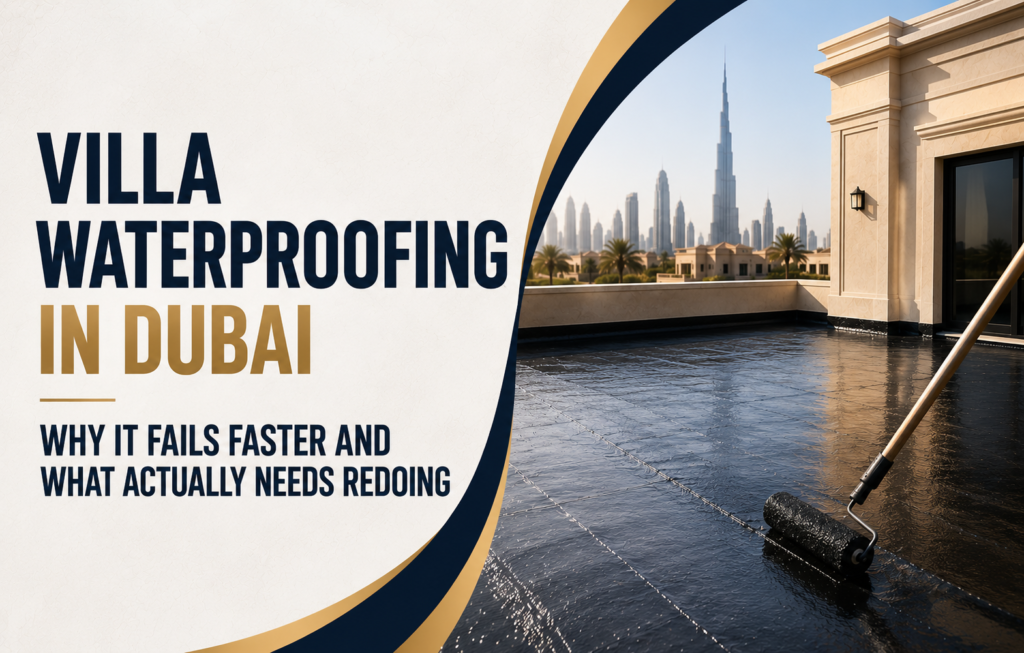
A stain on a ceiling that was not there last month. A damp patch that keeps returning to the same corner of a terrace wall no matter how many times it gets painted over. A renovation that starts as a kitchen refresh and turns into a conversation about the roof once someone actually looks up there. All three of these are usually the same underlying problem: waterproofing that has quietly failed, sometimes years before anyone noticed.
That timeline is shorter in Dubai than most homeowners expect. UAE waterproofing contractor Roofsealing.ae, quoted in Khaleej Times, reports that waterproofing systems in the UAE commonly fail within roughly two to five years of installation, well short of what someone used to a temperate climate would assume a properly waterproofed roof should last. This article explains why that happens, what the early warning signs actually look like before a leak shows up, and what redoing waterproofing properly involves, rather than repeating the generic advice to “get it checked” without saying what that check should find.
Why Dubai's Climate Breaks Down Waterproofing So Much Faster
It is not simply that Dubai is hot. Waterproofing membranes fail through a specific, physically explainable mechanism, and Dubai’s climate stresses that mechanism harder and faster than most places a membrane manufacturer originally designed for.
Roofsealing.ae’s reported figures, via Khaleej Times, put rooftop surface temperatures at roughly 80 to 85 degrees Celsius, with daily temperature swings of around 30 degrees and coastal humidity reaching close to 90 percent. Each of those numbers maps to a real stress on the membrane itself. The heat accelerates the chemical breakdown of the material over time, a process most membranes are rated for under far milder conditions. The daily swing means the membrane is expanding and contracting every single day, not occasionally, and that repeated movement is what eventually causes embrittlement and cracking, particularly at seams and joints where two sections of membrane meet. High humidity adds a separate problem: moisture finding any gap that heat cycling has already opened, rather than staying on the surface where it belongs.
Put together, this is not one dramatic failure but a slow, cumulative one. A membrane installed correctly on day one does not fail all at once. It degrades a little with every hot afternoon and every cold night, and by the time a homeowner notices a stain, the underlying material has usually been compromised for a while.
The Warning Signs Homeowners Usually Miss
A visible leak is a late stage sign, not an early one. By the time water is actually coming through, the membrane has typically failed well before that point, and the damage has had time to spread through whatever is underneath it.
Earlier signs worth checking for, proactively rather than after a leak appears, include hairline staining on a ceiling that has not yet turned into an active drip, white or chalky mineral deposits on external walls below a roofline or terrace edge, a terrace or flat roof area that holds standing water for longer than it should after rain, membrane seams that have started to bubble or lift at the edges, and a musty smell in an enclosed roof void or service duct that was not there before. None of these on their own proves failure, but any of them is a reasonable prompt to have the membrane actually inspected rather than waited on.
Where Waterproofing Actually Fails on a Villa
Roof and terrace membranes. These are the most exposed surfaces on the entire property and, given the climate mechanics above, the fastest to show wear. Flat and low slope roofs, common on many Dubai villas, hold more direct sun exposure across more of the day than a steeply pitched roof would, which is part of why this is usually where problems start.
Wet areas. Bathrooms and kitchens have their own waterproofing layer, applied behind tiles rather than exposed to the sun, and failure here tends to show up differently: not as an obvious leak but as damage to the finishes around it, discoloured grout, a soft patch in a wall, or a smell that will not go away. Getting this right the first time matters because reopening it later usually means removing tiling to reach the membrane underneath, which is one reason waterproofing quality is something worth confirming directly as part of any bathroom renovation.
Podium decks and planters. Villas with landscaped terraces or planted areas above living space carry an additional risk that gets discussed less often: waterproofing under soil or paving, which is harder to inspect visually and easy to forget about until a ceiling below it starts showing signs.
What Redoing Waterproofing Actually Involves
A proper re-waterproofing job starts with removing the failed membrane and preparing the surface underneath it, not applying a new layer over the old one. Patching over a failed membrane can look like a fix in the short term, but it is usually a false economy, since the new layer is being bonded to a surface that has already broken down and will keep moving underneath it.
The scope differs significantly depending on where the failure is. A bathroom re-waterproof is a small area in absolute terms but a disruptive one, since tiles generally have to come up to reach the membrane and go back down afterward. A full roof or terrace re-membrane covers far more surface area but does not usually involve the same finishing disruption. Neither scope should be treated as routine maintenance you can defer indefinitely once a membrane has actually failed, since the cost of the damage that failed waterproofing causes to what is underneath it, structure, finishes, ceilings, tends to exceed the cost of the waterproofing work itself.
What this article will not do is compare specific membrane systems or quote a typical warranty length, since neither could be verified against a Dubai specific, credible source in the research for this piece. If a contractor quotes you a specific membrane system and warranty term, ask them to explain both in writing rather than accepting a generic “premium waterproofing” line, the same standard worth applying to any renovation quote.
How This Fits Into a Renovation Scope
Waterproofing is exactly the kind of thing that should be checked proactively as part of any renovation planning, not discovered halfway through a project once a wall comes down or a ceiling is opened up. A villa’s age is a reasonable prompt to have this checked, since even waterproofing that was done well when a property was built has, on the timeline described above, very likely needed attention at least once by the time a villa is a decade or more old.
If you are scoping a broader renovation and want to understand how a villa’s age affects what tends to need attention beyond waterproofing, structure, wiring, and plumbing among them, our guide to renovating an older villa in Dubai covers the same territory in more depth. For projects where waterproofing turns out to be part of a larger scope, our Complete Home and Villa Renovation team handles it as part of the same project rather than as a separate, disconnected trade.
Frequently Asked Questions
How often does waterproofing need to be redone in Dubai?
There is no fixed schedule, but reported industry experience from Roofsealing.ae, via Khaleej Times, puts common failure within roughly two to five years of installation given Dubai’s climate. Treat that as a reason to check membrane condition periodically, not as a guaranteed replacement date.
What are the first signs of waterproofing failure?
Hairline ceiling staining, mineral deposits on external walls, standing water on a terrace after rain, lifting at membrane seams, and a persistent musty smell in an enclosed roof space are all worth investigating before an actual leak appears.
Does a leak always mean the whole roof needs re-waterproofing?
Not necessarily. The right scope depends on what an inspection actually finds, whether the failure is localized or has spread across the membrane. Treat any quoted scope, larger or smaller, as something that should follow from an inspection rather than a guess.
Is bathroom waterproofing different from roof waterproofing?
The underlying purpose is the same, but the exposure and access are different. Roof and terrace membranes face direct sun and temperature swings; bathroom waterproofing sits behind tiles and tends to fail in ways that show up as damage to nearby finishes rather than an obvious leak.
Start With an Inspection, Not a Guess
The honest starting point for any waterproofing concern is the same one we have used elsewhere on this site for renovation scoping generally: an actual inspection tells you more than an assumption based on how old the property is or how long it has been since the roof was last touched. If you have noticed any of the warning signs above, or you are planning a renovation on a villa old enough that waterproofing has not been checked in years, get in touch about a villa renovation consultation and start with what your property actually needs.