


Yes, in almost every case. Under Dubai’s Local Order No. 3 of 1999 Regulating Construction Works, Article 4 states plainly that no person may carry out work that changes the features of a property, “whether in whole or in part,” without first obtaining a permit from the competent department. That is the law, not a company’s marketing claim, and it serves as the starting point for every villa renovation in Dubai, from a full structural extension down to certain interior modifications.
What is harder to find is a straight answer on what that actually means for your project, who approves what, and what happens if you skip it. Search for “villa renovation permit Dubai” and you will find dozens of guides with confident-looking fee tables and fine amounts, yet almost none of them link back to the regulation, the authority, or any source at all. We checked. This guide is built the other way around: every figure below is tied to an actual source, and where we could not verify something, we say so instead of filling the gap with a plausible-sounding number.
The legal foundation for renovation approvals in Dubai is Local Order No. 3 of 1999, which remains the operative law governing construction works in the Emirate. Two articles matter most to a homeowner:
- Article 4: Requires a permit from the Competent Department before any work that permanently or temporarily changes the features of land or a property, in whole or in part.
- Article 3: Defines “Illegal Construction Works” as any work that is not permitted under the Order, or that is carried out in breach of the terms of an issued permit.
In practice, this means the law does not distinguish between “renovation” and “construction.” If the work changes the physical features of your villa, it falls under the same permitting requirement as new construction. That is a broader net than most homeowners assume, and it is why structural work such as villa extensions (adding a room, extending a footprint, or altering load-bearing elements) needs formal approval before a single wall comes down, not after.
Approval Authorities
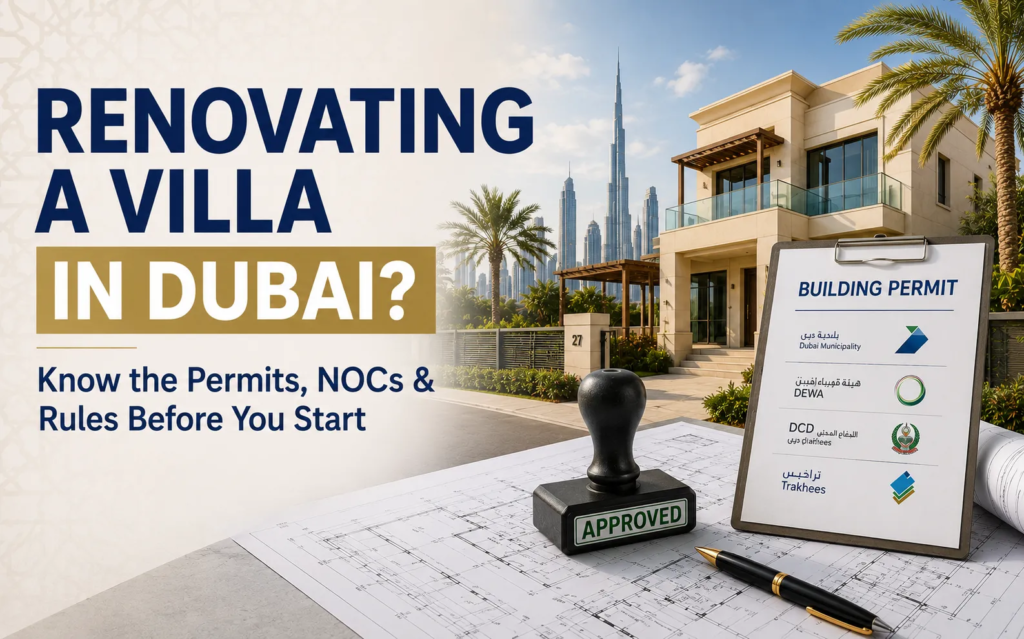
Dubai does not have one central office that signs off on renovations. Depending on your community and the scope of work, you may need approval from up to four different authorities:
- Dubai Municipality (DM): DM is the default building-permit authority for most freehold villa communities in Dubai. Its published FAQ on building permit procedures references Circular No. 231 of 2018, which governs self-licensing for decoration work in villas, a streamlined route that exists specifically because DM recognizes not every interior change needs the same process as a structural permit. The FAQ also points applicants toward the Dubai Building Permit System (the online portal DM uses to process permit applications) rather than a manual, paper-based process. What DM’s public FAQ does not spell out, at least not in the document we reviewed, is a specific calendar-day timeline for a full renovation permit, or a published fee schedule for villa modification work. We are flagging that gap deliberately: several competitor guides quote exact fee figures here, and none of the ones we checked cited where those numbers came from. Until DM publishes that information directly, or your engineer confirms it against your specific submission, treat any online fee figure, including any you see on renovation-company websites, as unconfirmed.
- Dubai Electricity and Water Authority (DEWA): If your renovation touches electrical wiring or plumbing, which most kitchen, bathroom, MEP, and structural projects do, DEWA needs to sign off separately from DM. This is one of the few places in this entire topic where the timeline is actually published: according to DEWA’s own May 2025 announcement on its digital NOC process, electrical NOCs are processed within two working days, and water NOCs within three working days, when applied for directly through DEWA’s channel. Where the NOC is tied to a Dubai Municipality building permit and processed through the integrated Dubai Building Permit System, DEWA states a three-working-day turnaround. These are DEWA’s own published figures, not a contractor’s estimate, which is why we can state them with confidence here, unlike most of the numbers floating around this topic online. This is also the point where MEP scope matters most: any renovation that reroutes electrical circuits, adds new water points, or changes your villa’s load profile is the kind of work that triggers this NOC, and getting the MEP design right the first time avoids a second, slower resubmission.
- Dubai Civil Defence (DCD): Civil Defence approval covers fire and life-safety compliance and typically comes into play for larger-scope renovations, such as significant structural change, new enclosed spaces, or work affecting escape routes and fire-rated elements. We did not find a published DCD fee schedule or processing-time figure from an official Civil Defence source during this research, so we are not going to quote one. If your renovation involves this level of change, confirm current requirements directly with DCD or with your project’s engineering consultant before finalizing a timeline.
- Trakhees: If your villa sits in a community developed by Nakheel, DP World, or a related master developer (Palm Jumeirah is the most commonly cited example), approvals are widely reported to run through Trakhees rather than directly through Dubai Municipality. We want to be precise about the strength of that claim: in this research pass, we found this stated consistently across multiple third-party sources, but we did not independently verify it against an official Trakhees publication. If you own a villa in one of these communities, confirm your approval route with your community’s developer or Trakhees directly before assuming DM’s process applies, as the two systems are not interchangeable.
Permit Applicability Matrix
Not every change to a villa triggers the full permit process. Based on what is actually published (Circular No. 231 of 2018’s existence for decoration work is itself evidence that DM treats cosmetic and structural changes differently), here is a working breakdown. Where we cannot point to a specific published source for a category, we say so rather than guessing.
| Renovation Type | Typical Approval Route | Confirmed By |
|---|---|---|
| Like-for-like finishes (paint, wallpaper, floor tile replacement without structural change) | Often falls under DM's self-licensing / decoration route (Circular No. 231 of 2018) | Dubai Municipality FAQ |
| Kitchen or bathroom renovation involving new electrical/plumbing points | DM decoration route + DEWA NOC | DM FAQ (decoration route); DEWA (NOC requirement for electrical/water work) |
| Removing or altering a load-bearing wall | Full DM building permit, engineering submission | Local Order No. 3 of 1999, Art. 4 (general permit mandate; specific structural process not independently confirmed in this research) |
| Villa extension (new room, added floor area) | Full DM building permit + DEWA NOC, potentially DCD | Local Order No. 3 of 1999, Art. 4; DEWA NOC process |
| Palm Jumeirah / Nakheel-developed community renovation | Trakhees process (route, not fee, widely reported) | Not independently confirmed from an official Trakhees source; confirm directly |
If you are weighing a renovation that adds real value rather than just refreshing finishes, it is worth reading this alongside our guide to what actually moves villa resale value in Dubai’s 2026 market and our renovation budget planning guide. Approvals and budget planning have to happen in the same conversation, not sequentially, because a permit rejection after work has started is the single most common cause of cost overrun on structural projects.
Penalties for Non-Compliance
This is where most online guides get vague or exaggerate for effect. Here is what Local Order No. 3 of 1999 actually says. Article 28 sets out the penalties for illegal construction works:
- A fine of up to AED 50,000, doubled for repeat violations
- Disconnection of utility services, for a period set by the competent department
- Blocking of future permit issuance or renewal for the violator
- Suspension or revocation of professional or commercial licences for engineers or contractors with repeated violations
Article 26 goes further for the physical work itself: authorities can order the demolition of illegal structures and recover the cost of that demolition from the owner or contractor, plus an additional 20% of those costs as an administrative fee.
Read together, the real risk is not just a fine. It is that unpermitted structural work can be ordered demolished, at the owner’s expense, with a further cost penalty on top, after the renovation budget has already been spent once. That is the actual, sourced version of the “why permits matter” argument, and it is a materially different (and more serious) risk than the generic warnings most renovation-company guides give without citing where the numbers came from. This is also a good filter question when choosing a contractor for a renovation project: ask directly who is responsible for obtaining approvals, and get that responsibility written into the contract before work starts, not handled informally.
Processing Timelines
We can only confirm what is actually published:
- DEWA Electrical NOC: 2 working days (applied through DEWA’s own channel)
- DEWA Water NOC: 3 working days (applied through DEWA’s own channel)
- Integrated DEWA NOC: 3 working days (processed via the integrated Dubai Building Permit System tied to a DM building permit)
What we could not find, from Dubai Municipality or any official source, is a published end-to-end timeline for a full villa renovation or extension permit, from submission to approval. Every “X weeks” figure we encountered while researching this topic came from a renovation company’s own guide, with no source attached. If your project involves more than the DEWA-covered scope above (which, for a full extension, it will), ask your contractor or engineering consultant for a timeline based on your specific submission rather than a generic industry figure. Treat any quoted number that is not attributed to DM or DEWA the same way we are asking you to treat it here: as an estimate, not a fact. For structural work specifically, our guide to structural retrofitting for Dubai villas covers what the engineering assessment and submission process typically involves in more technical detail.
Approvals Management with Wahat Babil
Wahat Babil has operated in Dubai’s renovation market since 2006 and holds a full electromechanical license, which covers the MEP scope that triggers most DEWA NOC requirements on a typical villa project. On structural and complete villa renovation projects, approvals coordination (Dubai Municipality submission, DEWA NOC, and Civil Defence sign-off where applicable) is handled as part of the project scope rather than left to the homeowner to navigate separately.
We are not going to attach a specific “number of permits obtained” or a client quote to this article, because we have not confirmed either with our own project records at the time of writing, and this guide is built around not doing that. If you want the specifics of how approvals were handled on a real project, our Meadows Villa 30 structural transformation case study is a genuine example of completed structural work; we would rather point you to documented projects than assert a number we cannot back up.
Frequently Asked Questions
- Do I need a permit to renovate my villa in Dubai?
In most cases, yes. Local Order No. 3 of 1999, Article 4, requires a permit from the competent department for any work that changes a property’s features, in whole or in part. Purely cosmetic, like-for-like work may fall under Dubai Municipality’s simplified self-licensing route for decoration (Circular No. 231 of 2018); structural or MEP-altering work requires the full process. - What is the “self-licensing for decoration” route under Circular No. 231 of 2018?
It is a Dubai Municipality circular, referenced in DM’s own building-permit FAQ, that provides a streamlined licensing path for decoration-level work in villas, as distinct from full structural permits. The FAQ confirms the circular exists but does not detail every qualifying scope. Confirm your specific renovation against it directly with DM or your engineering consultant. - Does DEWA need to approve renovation work?
Yes, whenever the work involves electrical or water/plumbing changes. DEWA’s own published process gives a 2-working-day turnaround for electrical NOCs and 3 working days for water NOCs and for NOCs processed through the integrated Dubai Building Permit System. - What happens if I renovate without a permit in Dubai?
Under Article 28 of Local Order No. 3 of 1999, penalties include a fine of up to AED 50,000 (doubled for repeat violations), utility disconnection, and blocked future permit issuance. Under Article 26, authorities can also order demolition of the unpermitted work and recover the cost from the owner or contractor, plus a 20% administrative fee. - Is Trakhees the same as Dubai Municipality?
No. Trakhees is widely reported to be the approving authority for Nakheel- and DP World-developed communities, including Palm Jumeirah, rather than Dubai Municipality directly, but we were not able to independently verify this through an official Trakhees source in this research. If your villa is in one of these communities, confirm the correct approval route directly with your community developer before proceeding.
This article cites Dubai’s Local Order No. 3 of 1999 (via the Dubai Legislation Portal), Dubai Municipality’s official Buildings Permit FAQ, and DEWA’s official NOC process announcement, current as of August 2026. Regulations and processing times can change; confirm current requirements with the relevant authority before starting work. Planning a villa extension or full renovation in Dubai? Talk to Wahat Babil about how we coordinate approvals as part of the project.