


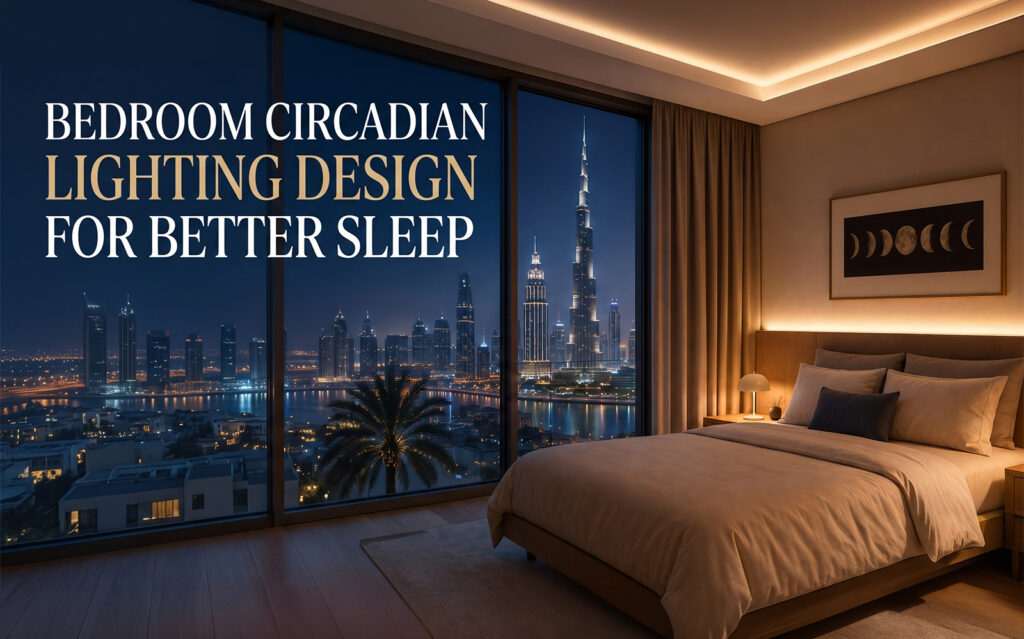
Bedroom lighting is one of the most overlooked factors in poor sleep. Light’s color, intensity, and timing tell the brain when to feel alert and when to rest and in most modern homes, those signals work against the body. This guide covers the biology of light and sleep, what “circadian-friendly” lighting means, and how smart lighting design fixes it.
What Is Circadian Rhythm Lighting?
Circadian rhythm lighting changes color temperature and intensity throughout the day to match the natural progression of sunlight, supporting the body’s internal clock instead of disrupting it. This clock, the suprachiasmatic nucleus, sits in the brain’s hypothalamus and coordinates sleep, hormones, body temperature, and alertness on a roughly 24-hour cycle.
Sunlight normally sets that clock daily bright and blue-rich in the morning, warm and dim by evening. Indoor lighting rarely follows this pattern; a fixed color temperature used all day gives the brain no clear signal of the time, which is where sleep problems begin.
How Does Light Affect Melatonin and Sleep?
Light affects sleep by controlling melatonin, the hormone that signals the body to prepare for rest. Bright, blue-enriched light suppresses melatonin and triggers cortisol release, which raises heart rate and alertness helpful in the morning, harmful at night.
This response is driven by intrinsically photosensitive retinal ganglion cells (ipRGCs), eye cells containing the photopigment melanopsin, most sensitive to blue light around 480 nanometers. When melanopsin is activated, it signals the suprachiasmatic nucleus that it’s daytime.
Scientists measure this using Equivalent Melanopic Lux (EML), distinct from standard lux: it captures how strongly light stimulates the circadian system rather than how bright it looks. Two lights can read identically in regular lux and still have very different melanopic effects depending on their color spectrum.
Getting this wrong has consequences beyond feeling awake: artificial light at night even at low levels can suppress melatonin, shift sleep timing, reduce heart rate variability, lower blood oxygen saturation, and delay the drop in core body temperature that sleep onset depends on.
Sensitivity also changes with age. Children have larger pupils and clearer lenses, making them more vulnerable to melatonin suppression from evening light. Older adults’ lenses yellow and thicken over time, naturally filtering blue light — so they need brighter daytime light to stay entrained.
| Observer Age | Light Type | Light at the Eye | Circadian Effect |
|---|---|---|---|
| Child (10 yrs) | Daylight-type white light | 200 lux | Strong stimulation; vulnerable to evening exposure |
| Older adult (90 yrs) | Daylight-type white light | 200 lux | Weaker stimulation; needs more daytime brightness |
| Child (10 yrs) | Warm incandescent-type light | 200 lux | Moderate stimulation |
| Older adult (90 yrs) | Warm incandescent-type light | 200 lux | Low stimulation |
What Color Temperature Is Best for Sleep?
The best color temperature for sleep is warm white light, roughly 2200K–2700K, in the hour or two before bed and overnight. Cooler, bluer light in the 4000K–6500K range suits mornings and midday, supporting alertness instead of working against it.
Color temperature (Kelvin, K) describes how warm or cool light appears lower numbers look amber, higher numbers blue-white. A well-designed scheme shifts gradually across the day rather than staying fixed:
| Time of Day | Target Color Temperature | Target Brightness | Why |
|---|---|---|---|
| Early morning (5–7am) | 2200K → 2700K | 1% → 30% | Gentle wake-up, mimicking sunrise |
| Morning (7–10am) | 4000K → 4500K | 80–100% | Clears residual melatonin |
| Midday (10am–4pm) | 4500K → 5000K | 100% | Replaces natural daylight indoors |
| Late afternoon (4–7pm) | 4500K → 3500K | 100% → 70% | Eases alertness down |
| Evening (7–10pm) | 2700K | 50% → 20% | Supports melatonin release |
| Night (10pm–5am) | 2200K → 2400K | Under 10%, or under 1 melanopic lux | Minimal disruption overnight |
A single warm bulb at full brightness all evening doesn’t achieve this intensity and gradual color shift both matter, not color alone.
Why Is Sleep Quality Often Poor in UAE Homes Specifically?
Sleep quality is often poor in UAE homes because the same design choices that manage extreme heat also block the natural light cues the body needs. Blackout shades used by day to control solar heat gain shut out the morning light that should signal “daytime,” while bright indoor and facade lighting at night sends exactly the wrong cue at the wrong time.
Regional health data reflects this: a large share of Dubai residents report at least one sleep disorder, most commonly insomnia, sleep-related breathing problems, and circadian disruption, often alongside heavy evening screen use. Dense residential towers add another layer of facade lighting on nearby buildings that can shine directly into bedrooms through floor-to-ceiling glazing, since heat-blocking coatings filter infrared, not the blue light that disrupts circadian rhythm. Tightly sealed homes can also trap exhaled CO₂ overnight, which is linked to more fragmented sleep.
What Does "Circadian-Friendly" Lighting Design Actually Require?
Genuine circadian-friendly lighting needs more than a warm-toned smart bulb — it requires fixtures and controls built to shift color and brightness automatically across the day.
The core technology is tunable white LED lighting, combining a warm and cool channel in one fixture, blended in different ratios through the day and typically run on a DALI-2 DT8 control protocol, which dims and mixes color precisely, without flicker, down to very low levels. Two details matter most: deep, flicker-free dimming for barely-perceptible night lighting, and consistent color rendering, so fixtures don’t drift in tone as LEDs warm up.
These systems also need a reliable network; wireless smart bulbs tend to suffer latency in larger homes, so most high-end installations use a wired backbone: commonly Lutron for lighting and shading, KNX for climate integration, and Control4 or Crestron to unify everything into simple household scenes.
What Do Green Building and Wellness Standards Say About Bedroom Lighting?
Several standards address circadian lighting directly. Al Sa’fat, Dubai’s mandatory green building code, focuses on lighting efficiency and outdoor light spillage. Estidama, Abu Dhabi’s program, requires daylighting simulations balancing daylight access against heat gain. Neither sets a direct circadian metric.
The WELL Building Standard, a voluntary wellness certification, does: Feature L05 caps sleep-space light at roughly 10 EML after 9pm; Feature L06 requires at least two scheduled color/intensity transitions daily, faded over 30–60 minutes; Feature L07 requires daylight views without excessive glare, since glare-prone rooms often end up with blinds permanently shut. Asking a designer to meet the WELL EML thresholds is a practical way to ensure a bedroom is genuinely sleep-supportive.
How Smart Lighting Systems Solve This
Meeting all of the above manually dimming lights, shifting color, closing shades at the right moments daily isn’t realistic for most households. An integrated smart lighting system does this automatically, using an astronomical clock calibrated to the home’s location to run the curve above without manual input, adjusting as sunrise and sunset shift across seasons. The same system typically ties into motorized shading and climate control, so one “Goodnight” scene dims the lights, closes the blackouts, and lowers the temperature together.
At Wahat Babil, we design and install these systems as a coordinated whole: tunable LED fixtures on DALI-2 control, integrated with shading and climate automation, operated through simple physical keypad scenes “Bright,” “Relax,” “Goodnight” placed within reach of the bed so residents aren’t reaching for a phone screen before sleep.
If you’re planning a new build or renovation and want a bedroom designed around genuine sleep science rather than off-the-shelf smart bulbs, our team can walk through what a circadian lighting specification looks like for your home.
Frequently Asked Questions
What is the best light color for sleeping?
Warm white light, roughly 2200K–2700K and dimmed low, is best before bed and overnight. Cooler, bluer light suits daytime hours, supporting alertness rather than disrupting sleep.
Does blue light really affect sleep quality?
Yes. Blue-enriched light activates light-sensitive eye cells that suppress melatonin and raise alertness hormones useful by day, disruptive to sleep onset and quality at night.
What is Equivalent Melanopic Lux (EML)?
EML measures how strongly a light source stimulates the circadian system, unlike standard lux, which only measures visible brightness. WELL recommends bedroom light stay under about 10 EML after 9pm.
Can smart lighting improve sleep?
Yes lighting that automatically shifts color and brightness across the day, bright and cool in the morning and warm and dim at night, supports healthier melatonin timing and more consistent sleep.
What lighting standards apply to bedrooms in the UAE?
Al Sa’fat (Dubai) and Estidama (Abu Dhabi) are mandatory codes addressing efficiency and light pollution. WELL is a voluntary certification with specific circadian thresholds for sleep spaces.