


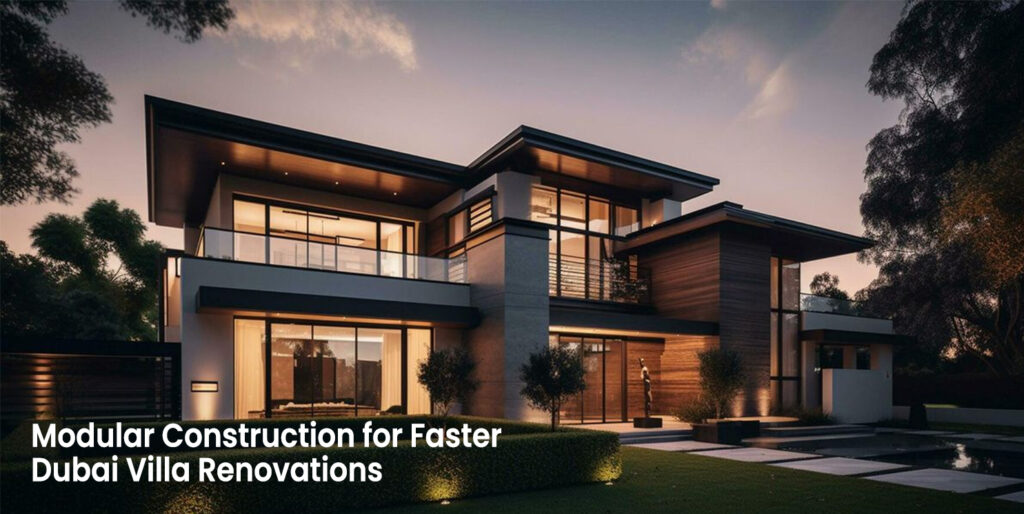
Dubai's Construction Evolution
Dubai’s construction sector is experiencing a profound transformation as the city’s established residential communities reach maturity. For decades, development focused on horizontal expansion and greenfield mega-projects. Today, the emphasis has shifted toward sophisticated renovation and extension of existing assets in mature communities like Jumeirah, Arabian Ranches, Emirates Hills, and The Meadows.
This evolution reflects Dubai’s strategic response to annual population growth exceeding 3%, creating supply-demand imbalances that traditional construction methods struggle to address. Urban sprawl threatens environmental sustainability goals, making Modern Methods of Construction (MMC)—particularly modular systems and 3D printing—essential for maintaining Dubai’s competitive edge in global luxury real estate.
The traditional renovation model faces increasing inefficiency challenges. Homeowners typically encounter space constraints within five to seven years as family needs evolve, requiring additional bedrooms, home offices, or expanded kitchens. Conventional on-site construction projects suffer from noise, dust, and labor-intensive processes stretching 18-24 months, disrupting daily life and neighborhood tranquility.
The Dubai Landscape: Challenges Driving Innovation
Population Growth and Supply Constraints
Dubai’s rapid population expansion creates persistent housing pressure in established communities where new construction opportunities are limited. Premium villa communities command substantial price premiums due to location, mature infrastructure, and established reputations—making strategic renovation and extension more economically rational than relocation.
Traditional Construction Limitations
Conventional construction methods face multiple challenges in Dubai’s mature residential environments:
- Extended timelines: 18-24 month project durations causing prolonged household disruption
- Material waste: 20-30% waste rates contributing to landfill pressure and environmental concerns
- Weather dependency: Outdoor construction vulnerable to extreme heat, sandstorms, and humidity
- Quality variability: Site conditions creating inconsistent results across different trades
- Labor coordination: Managing 8-10 different trades in small spaces causing scheduling conflicts
Regulatory and Environmental Pressures
Dubai’s sustainability mandates, including the 2040 Urban Master Plan and Al Sa’fat green building rating system, require construction methods delivering measurable environmental improvements. Traditional approaches struggle meeting mandatory energy efficiency, waste reduction, and carbon footprint targets.
Modern Construction Solutions: Modular and Additive Manufacturing
Modular Construction Advantages
Modular construction shifts the majority of building processes to factory-controlled environments, delivering transformative benefits:
Timeline Compression:
- 30-60% reduction in project duration compared to traditional methods
- Factory fabrication occurring parallel to on-site foundation work
- 5-12 month completion timelines versus 18-24 months traditionally
Quality and Consistency:
- ISO-controlled factory environments ensuring consistent quality
- Precision manufacturing eliminating site condition variability
- Rigorous quality control at each production stage
Waste Reduction:
- Material waste rates as low as 1.8% versus 20-30% traditional construction
- Precision material cutting and factory recycling systems
- Reduced transportation requirements lowering carbon emissions 30-40%
Volumetric vs. Panelized Systems
Volumetric Construction: Complete three-dimensional modules manufactured in factories arrive as pre-finished units containing structure, finishes, and fully integrated MEP systems. Modules are craned into position on prepared foundations, with final work limited to utility connections and minor touch-ups. This approach compresses timelines dramatically but faces transportation constraints within Dubai’s road networks.
Panelized Systems: Individual wall, floor, and roof panels prefabricated off-site ship in flat-pack bundles for on-site assembly. This approach offers greater geometric flexibility for complex designs while maintaining 30-40% timeline reductions. Panelized systems suit established neighborhoods with limited street access where standard-sized vehicle transport provides decisive advantages.
Prefabricated Bathroom and Utility Pods
High-complexity modular components, particularly bathroom pods, represent significant advancement in Dubai renovation markets. Traditional bathroom construction requires coordinating 8-10 different trades in confined spaces, creating scheduling conflicts and quality variability.
Industrialized Production Process: The 12-step sequences ensures consistency:
- Precision mould creation
- Structural shell casting
- Floor waterproofing application
- Controlled-environment tiling
- MEP system integration
- Comprehensive leak testing
- Final fixture installation
Pods install through rooftop openings or enlarged windows, reducing worker presence inside homes from weeks to days while delivering superior material quality and finish consistency.
3D Printing Technology
Dubai’s 3D Printing Strategy mandates 25% of buildings utilize additive manufacturing by 2030. Advanced robotic systems like COBOD BOD2 gantry printers and MaxiPrinter mobile arms enable on-site construction with single-operator functionality.
Key Advantages:
- 50% reduction in construction waste through precision material deposition
- Significantly lower noise pollution valued in established communities
- Ability to create complex geometries impossible with conventional formwork
- Integration of high-performance insulation directly into wall structures
The world’s largest 3D-printed villa, completed in Dubai 2023, demonstrates technology enabling curved walls and organic spaces blending harmoniously with desert-inspired architecture.
Economic Benefits: ROI and Cost Certainty
Extension vs. Relocation Economics
The financial case for strategic villa extension versus relocation is compelling. Total relocation expenses—including 2% agent fees, mortgage arrangement costs, moving logistics, and larger property premiums—can exceed AED 2.2 million for typical 6-bedroom villas.
By contrast, strategically planned modular extensions of 1,200 square feet cost approximately AED 850,000 while increasing property market valuation 15-30%. Extensions prove 40-60% less expensive per square foot than purchasing additional space through relocation.
Budget Predictability
Traditional construction projects experience mid-build price escalations due to weather interruptions, labor shortages, and material fluctuations. Modular construction mitigates risks through factory environments with fixed-price contracts and tighter quality control.
Financial Advantages:
- Up to 20% overall project cost reduction through eliminated inefficiency
- 50% faster completion reducing interest payments on development loans
- Minimized carrying costs and opportunity costs
- Rapid return on investment through accelerated occupancy
Regulatory Framework and Compliance
Dubai Municipality Requirements
Dubai Municipality Decree No. 24 of 2021 mandates all 3D printing construction requires permits with engineers and contractors registered in specific 3D printing registers. Raw materials and concrete mixtures must meet verified engineering standards ensuring structural integrity and fire safety compliance.
Al Sa’fat Green Building Rating
Mandatory for all additions and extensions requiring building permits, Al Sa’fat classifies buildings into Bronze, Silver, Gold, and Platinum ratings based on:
- Energy efficiency through high-performance envelopes and advanced HVAC controls
- Water conservation via low-flow fixtures and greywater recycling
- Indoor air quality using low-VOC materials and proper ventilation
- Resource management prioritizing lower embodied carbon materials
Gold and Platinum compliance increasingly commands higher rental premiums and resale values in ESG-conscious markets.
Community Developer Approvals
Beyond municipal regulations, homeowners must obtain No Objection Certificates (NOCs) from community developers like Emaar or Nakheel. These enforce strict architectural codes maintaining neighborhood aesthetic integrity—Spanish-influenced designs in The Meadows, traditional Arabian architecture in Arabian Ranches.
The Role of Professional Construction Partners
Why Expertise Matters
Modern construction methods require specialized knowledge extending beyond traditional contracting capabilities. Professional partners must navigate:
- Complex regulatory frameworks across multiple approval authorities
- Factory coordination and logistics management
- BIM and DfMA digital integration ensuring clash-free installation
- Transportation permits and aviation easement requirements
- Community-specific architectural guidelines and staging protocols
Integrated Service Delivery
Successful villa transformations demand coordinated execution across multiple technical disciplines. Fragmented approaches using disconnected specialists inevitably result in communication failures, timeline delays, and quality inconsistencies.
Professional partners offering integrated service delivery—where design, engineering, manufacturing coordination, and regulatory compliance function under unified project management—consistently deliver superior outcomes with predictable timelines and controlled costs.
Wahat Babil: Engineering Excellence in Modern Villa Transformation
Since 2006, Wahat Babil has specialized in engineering-first villa renovations throughout Dubai’s premium communities. With 18 years of experience and over 75 successful transformations, we understand the precise technical requirements defining success in Dubai’s evolving construction landscape.
Our comprehensive approach embraces modern construction methods while maintaining traditional craftsmanship where appropriate, treating each project as integrated engineering challenge requiring coordinated solutions across multiple disciplines.
Complete Renovation Service Portfolio
- Interior Designing Services
- MEP Services (Mechanical, Electrical & Plumbing)
- Ceiling Work
- Home Renovation Services
- Villa Renovation Services
- Bathroom Renovation
- Kitchen Renovation
- Structural Villa Extension
- AC Services (Maintenance, Repair & Installation)
- Painting Works
- Tiling Works
The Wahat Babil Difference
What distinguishes our work is adaptability and technical depth. We evaluate each project individually, recommending optimal construction methodologies—traditional, modular, or hybrid approaches—based on site constraints, timeline requirements, budget parameters, and architectural objectives.
Our structural engineers coordinate with modular manufacturers when appropriate. Our MEP specialists integrate prefabricated pods seamlessly with existing systems. Our regulatory experts navigate municipal, master developer, and aviation authority approvals. Everything functions together because we engineer it together from conception.
Building Dubai's Future
Dubai’s villa renovation sector stands at the threshold of fundamental transformation. Modern methods of construction—modular systems and 3D printing—offer compelling solutions to challenges of timeline compression, quality consistency, environmental sustainability, and cost certainty.
Success in this evolving landscape demands professional partners combining traditional construction expertise with modern manufacturing coordination capabilities, regulatory knowledge, and logistics management skills. The difference between projects that achieve transformative results and those that create expensive complications lies in this integrated approach.
Transform your villa using Dubai’s most advanced construction methodologies. Contact Wahat Babil for consultation about renovation strategies combining traditional craftsmanship with modern innovation.