


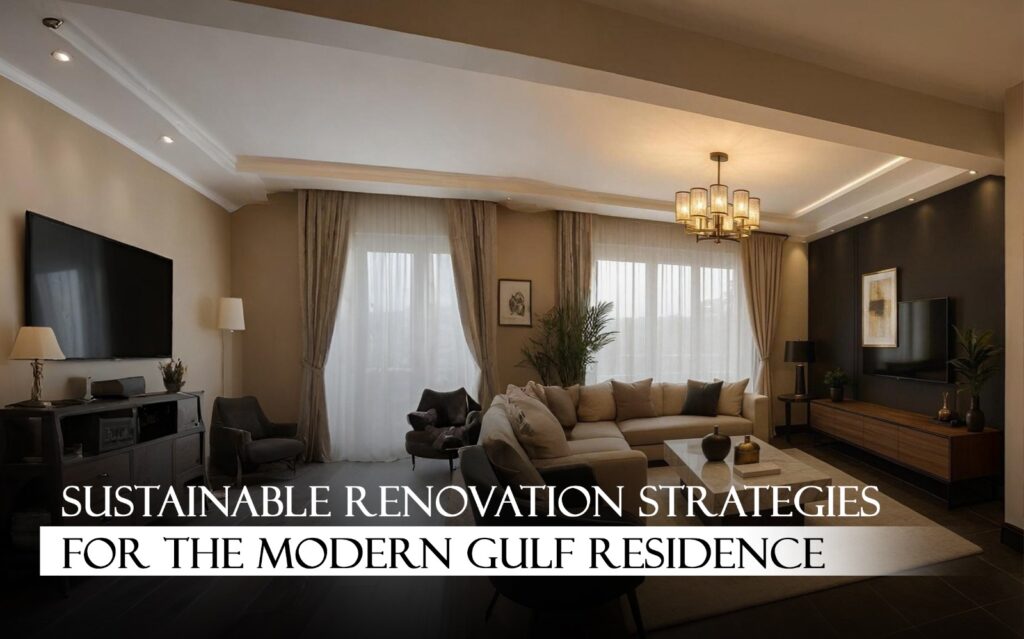
Dubai stands at a critical juncture. As the emirate accelerates toward the UAE’s Net Zero by 2050 strategy and Vision 2071, residential property renovation has transformed from aesthetic preference into environmental and economic imperative. In a region where cooling demand accounts for over 60% of total energy consumption and summer temperatures routinely exceed 45°C, sustainable renovation isn’t just about installing solar panels—it’s about fundamentally reimagining how homes interact with one of the planet’s most challenging climates.
The core message is clear: Your home is currently fighting against Dubai’s extreme environment rather than working with it. Every month, you’re paying the financial and environmental cost through skyrocketing DEWA bills, uncomfortable indoor temperatures despite AC running constantly, and a property losing value as sustainability regulations tighten.
For homeowners, the financial case is compelling: properly executed sustainable renovations deliver 25-50% energy savings, achieve payback periods as short as 4-8 years, and command 5-20% property value premiums in Dubai’s competitive real estate market.
Dubai's Regulatory Framework: Al Sa'fat Compliance
Dubai’s sustainability standards are anchored by the Al Sa’fat Green Building Rating System. To secure building permits, all significant refurbishments must achieve Bronze Sa’fa rating as absolute baseline. Many developments now require Silver Sa’fa as minimum threshold.
Performance Targets: Silver Sa’fa delivers 19% energy savings, Gold achieves 32% savings, and Platinum Sa’fa targets over 35% savings through comprehensive approaches including solar thermal cooling and battery storage.
The reality: If your villa was built before 2015, it likely fails to meet even Bronze standards. Your property isn’t just inefficient—it’s functionally obsolete under current regulations, limiting renovation options, refinancing potential, and resale value.
The Building Envelope: Your First Line of Defense
Here’s what’s actually happening: Heat is transferring through your building envelope at rates three to four times higher than code-compliant construction. Your AC isn’t struggling because it’s undersized—it’s struggling because your home has no thermal defense whatsoever.
Thermal Insulation and Reflective Technologies
Retrofitting envelopes with high-performance insulation prevents conductive heat transfer forcing AC systems to work continuously. Application of reflective insulation on external walls and roofs offers 25-50% energy savings—the single most impactful intervention available.
Modern insulation materials include mineral wool (fire-resistant with excellent thermal/acoustic properties), aerogel (superior insulation in thin profiles), and bio-based foams. Critical R-value targets: minimum 1.35 m²K/W for walls and 1.75 m²K/W for roofs.
High-Performance Glazing: Stopping Heat at the Source
The truth about your windows: If you have single-pane glass, you’re essentially air conditioning the outdoors while paying full price.
Double glazed Low-E windows (U-value ~1.6) deliver 35-40% energy savings, while triple glazed systems (U-value ~0.8) achieve 45-55% savings. Low-emissivity coatings selectively reflect infrared radiation while allowing visible light penetration, dramatically reducing the “greenhouse effect” inside homes.
Modern Mashrabiya: Heritage Meets High-Tech Shading
External shading intercepts solar radiation before it strikes glazing—fundamentally more efficient than internal blinds. Modern Mashrabiya systems using CNC-cut aluminum or steel deliver approximately 20% cooling load reduction. Strategic shading by orientation: East/West elevations require up to 60% opacity, South elevations need 40-50%, while North elevations only need 25%.
Advanced HVAC: Intelligence Over Brute Force
What your AC is actually doing: Running at maximum capacity trying to overcome heat gain that should have been stopped at the building envelope—treating symptoms, not causes.
Inverter-driven systems modulate output matching actual cooling loads, avoiding energy spikes from constant on-off cycling. For larger villas, Variable Refrigerant Flow (VRF) systems provide granular zone control. Solar cooling integration achieves 44% greater lifecycle economy over 20 years compared to conventional systems.
Home Energy Management Systems regulate temperature, lighting, and humidity based on occupancy. Smart thermostats deliver 5-15% savings, intelligent lighting reduces loads ~80%, and smart appliances achieve 15-20% savings.
Solar Power: From Consumer to Prosumer
The opportunity you’re missing: Dubai averages over 6 kWh/m² of solar radiation daily. Your roof receives enough free energy to power your entire home—you’re just not capturing it.
Under the Shams Dubai initiative, homeowners connect rooftop solar to DEWA’s grid with net metering crediting surplus energy back at retail prices.
Typical residential solar economics:
- System size: 6-10 kW installation
- Cost range: AED 18,000-40,000
- Payback period: 4-8 years
- Property value impact: 5-20% resale premium
Technical challenges include dust accumulation reducing efficiency 10-30% without cleaning. Advanced renovations incorporate automated robotic cleaning systems and high-temperature-tolerant cells maximizing yields.
Water Intelligence: The Energy-Water Nexus
The hidden cost: Every liter of water you waste requires energy-intensive desalination. Your water consumption directly drives both DEWA water charges and your indirect energy footprint.
Xeriscaping: Desert-Appropriate Landscaping
Traditional lawns consume up to 50% of single-family home water supply. Xeriscaping creates aesthetically pleasing landscapes requiring 30-80% less water. Dubai Municipality’s Urban Master Plan 2040 mandates at least one Ghaf tree (UAE’s national tree) for all new villas, plus minimum 25% local or adapted species.
Greywater Recycling: Closing the Loop
Greywater—collected from showers, sinks, laundry—can be treated on-site for toilet flushing and landscape irrigation. Residential recycling reduces potable water demand 27% in single-family homes. Advanced Membrane Bioreactor (MBR) systems produce high-quality effluent safe for human contact and irrigation.
Coastal Challenges: Humidity and Mold Management
The invisible health threat: If you’re in a coastal area—JBR, Dubai Marina, Palm Jumeirah—and haven’t addressed humidity control, you likely have mold growing behind your walls, in AC ducts, and within ceiling voids.
Effective mitigation requires maintaining 30-50% indoor humidity, professional AC duct cleaning preventing mold spore circulation, moisture-resistant drywall, and antimicrobial paints blocking fungal growth
Choosing the Right Home Renovation Company in Dubai
The critical distinction: Sustainable renovation requires a home renovation company in Dubai with deep engineering expertise capable of integrating passive design, active systems, renewable energy, and water management into cohesive, high-performance homes.
Most renovation contractors operate as decorators—they can make spaces look beautiful, but they cannot engineer thermal performance, optimize energy systems, or deliver the measurable sustainability outcomes that regulations now mandate.
Wahat Babil: Your Engineering-First Sustainable Renovation Partner
Since 2006, Wahat Babil has specialized in engineering-first renovation, delivering 75+ villa transformations across Dubai with full electromechanical licensing and integrated approach essential for sustainable implementation.
Wahat Babil’s comprehensive services:
Complete Home Renovation: Villa and apartment transformations integrating all sustainable systems with phased approaches and single-point accountability.
Thermal Envelope Optimization: Insulation retrofitting with appropriate R-values, high-performance Low-E glazing, thermal bridge elimination, and modern Mashrabiya shading.
HVAC Integration & AC Services: High-efficiency inverter-driven or VRF systems, precise load calculations, solar cooling integration, smart thermostats, and comprehensive maintenance programs.
MEP Services: Complete mechanical, electrical, and plumbing integration as fully licensed contractor, electrical upgrades, high-performance plumbing materials, and smart energy management.
Solar Power Implementation: Complete Shams Dubai application and DEWA approval, rooftop PV system design, battery storage integration, and performance monitoring.
Water Management: Xeriscaping landscape design, smart irrigation controllers reducing consumption 50%, greywater recycling installation, and leak detection systems.
Villa Renovation & Extension: Large-scale transformations, structural extensions with thermal integrity, EIFS installation, and marine-grade specifications for coastal properties.
Bathroom Renovation: Comprehensive upgrades with proper waterproofing, vapor barriers, humidity-resistant materials, engineered ventilation, and antimicrobial finishes.
Kitchen Renovation: Climate-resilient cabinetry, marine-grade materials, advanced ventilation, and thermal-efficient appliance integration.
Additional Services: Interior design with climate-intelligent material selection, ceiling works with thermal breaks, UV-resistant painting, tiling with proper movement joints, structural services, Al Sa’fat certification support from Bronze through Platinum, and sustainable material specification.
The Wahat Babil Difference: Integrated Engineering Accountability
What distinguishes Wahat Babil is integrated accountability. Where typical “green” renovations consist of disconnected interventions, Wahat Babil’s engineering team designs complete systems where every component enhances others. The HVAC specialist coordinates directly with the insulation contractor and solar designer. Everything works together because it was engineered together.
Their methodology begins with comprehensive assessment: thermal imaging identifying envelope weaknesses, energy consumption analysis, system performance evaluation, moisture risk assessment, Al Sa’fat pathway planning, and regulatory compliance review.
The Investment in Your Future
Dubai’s trajectory toward Net Zero 2050 is inevitable and enforceable. Properties that cannot demonstrate measurable sustainability performance will face declining competitiveness as regulations tighten, utility costs rise, and buyer preferences shift toward green-certified homes. Your property will either be part of Dubai’s sustainable future or a stranded asset.
Contact Wahat Babil today for a comprehensive sustainability assessment. Let Dubai’s engineering-first home renovation company build you a property ready for 2050—efficient by design, sustainable by engineering, valuable by performance.
Wahat Babil | Engineering Excellence in Dubai Since 2006
Call now to schedule your free initial consultation and discover exactly how much your current property is costing you—and how much you could be saving.