


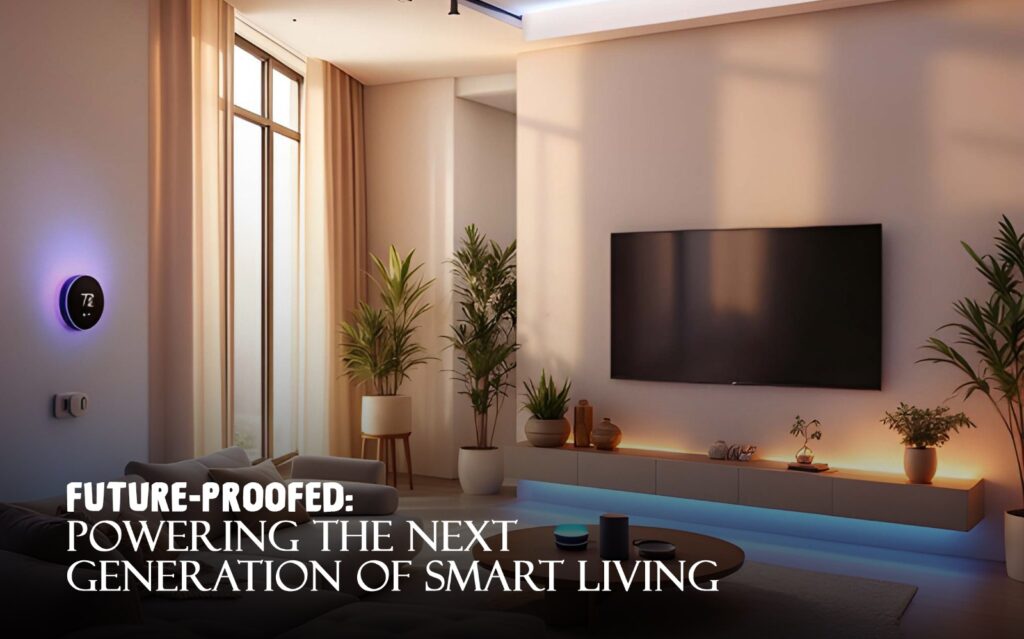
Dubai stands at the threshold of a technological revolution that will fundamentally transform how residents experience their homes. The UAE’s ambitious vision—codified in the UAE Centennial 2071 and Dubai 2040 Urban Master Plan—isn’t simply about adding smart devices to existing structures. It represents a comprehensive reimagining of residential living as an adaptive, data-driven ecosystem capable of anticipating occupant needs while delivering unprecedented efficiency, security, and comfort.
For homeowners and investors, the question is no longer whether to embrace smart living, but how to implement it with the engineering precision that ensures your property remains competitive, valuable, and technologically relevant for decades to come. This is where understanding the infrastructure, applications, and strategic implementation of future-proof technology becomes essential—and where the right renovation partner makes the difference between a gimmick-laden property and a genuinely intelligent home.
The Strategic Foundation: Dubai's Vision Meets Your Home
The UAE Centennial 2071 establishes four foundational pillars shaping the nation’s trajectory: future-focused government, excellent education systems, diversified knowledge-based economy, and a happy, cohesive society. These aren’t abstract policy statements—they translate directly into the technological infrastructure being built into Dubai’s urban fabric, infrastructure your home must integrate with to remain relevant.
The Dubai Economic Agenda (D33) aims to double Dubai’s economy by 2033, positioning the city among the top three global economic hubs. This economic ambition is inextricably linked to technological leadership, with massive government investment in artificial intelligence, biotechnology, and advanced telecommunications creating a quantum leap in capabilities. The Dubai 2040 Urban Master Plan provides the spatial realization, prioritizing the “20-Minute City” concept where 80% of residents’ daily needs—education, healthcare, retail—are reachable within 20 minutes by walking or cycling.
What this means for your property: Homes that cannot integrate with this intelligent urban fabric—that lack the connectivity infrastructure, energy management systems, and adaptive technologies the city is building toward—will face obsolescence. Properties designed for passive living in a city built for active intelligence will experience declining competitiveness, reduced tenant appeal, and diminished resale value.
The Connectivity Revolution: 5G to 6G Infrastructure
Dubai has achieved 5G coverage across 99.5% of populated areas with over 23,000 sites serving 10 million subscribers, providing the high-bandwidth, low-latency foundation for massive IoT deployments. Current 5G delivers data speeds up to 10 Gbps with latency as low as 1 millisecond—sufficient for current smart home applications, early autonomous vehicles, and telemedicine.
However, the Telecommunications and Digital Government Regulatory Authority (TDRA) has already launched the national 6G initiative targeting 2030 commercial rollout. The 6G roadmap will deliver speeds 100 times faster than 5G with latency reduced to microseconds, facilitating the “Internet of Senses”—digital transmission of touch, smell, and hyper-connected synchronization of billions of devices.
6G will enable home capabilities currently impossible:
- Native AI integration: Networks that self-optimize, predicting household usage patterns and automatically reallocating capacity
- Quantum communications: Unprecedented security making data interception virtually impossible through quantum cryptography
- Seamless satellite integration: Total service continuity even in remote areas, ensuring your smart home never loses connectivity
- 10 million devices per km²: Sufficient density for every surface, appliance, and system in your home to communicate intelligently
Critical home infrastructure requirements: Structured cabling supporting 10 Gbps+ throughput, future-compatible network equipment with upgrade pathways, distributed antenna systems for large villas ensuring complete coverage, and fiber-optic backbone connections providing municipal-grade bandwidth. Homes renovated without this infrastructure will require expensive retrofitting when 6G applications become standard—likely within 5-7 years.
Digital Twins and Cognitive Home Management
Digital Twin technology—virtual counterparts of physical assets merging live IoT sensor data with 3D Building Information Modeling—has become fundamental to Dubai’s urban development strategy. The One Za’abeel project utilized 4D modeling that shortened construction schedules by 70 days and saved $16 million by identifying potential errors in virtual environments before physical manifestation. The Burj Khalifa employs centralized management with sensors monitoring air quality, lighting, and temperature in real-time, enabling proactive maintenance and minimizing equipment downtime.
For luxury villas and high-end apartments, Digital Twin technology delivers:
Predictive maintenance
AI analyzing sensor data from HVAC, plumbing, and electrical systems identifies developing problems before failure occurs—preventing the catastrophic water damage, AC breakdowns, and electrical faults that plague conventionally managed propertiesEnergy optimization
Real-time modeling of thermal performance, occupancy patterns, and utility pricing enables automated adjustments reducing energy consumption 30-40% while maintaining superior comfortLifecycle asset management:
Complete digital records of all building systems, installations, and modifications create unprecedented transparency for future renovations, sales, or insurance claimsIntegration with city infrastructure:
As Dubai implements smart city management platforms like DANA, homes with Digital Twin integration will seamlessly coordinate with municipal services—automated permitting, utility optimization, emergency response coordination
Implementation requirements
Comprehensive IoT sensor networks monitoring critical systems, centralized Building Management Systems (BMS) aggregating data streams, cloud infrastructure storing and analyzing historical performance data, and professional integration ensuring sensors communicate accurately and systems respond appropriately.
Smart Energy: The Grid-to-Home Intelligence
Dubai’s Clean Energy Strategy 2050 targets 75% clean energy production by 2050, with the Mohammed bin Rashid Al Maktoum Solar Park providing massive renewable capacity. DEWA’s AED 7 billion smart grid investment through 2035 utilizes Fourth Industrial Revolution technologies—AI and IoT—ensuring 24/7 integrated services and automated decision-making.
The Automatic Smart Grid Restoration System (ASGR) operates without human intervention to locate, isolate, and restore power during faults. DEWA achieved world-record performance in 2023: electricity transmission losses of just 2% (compared to 6-7% in US/Europe) and Customer Minutes Lost of only 1.06 minutes per customer per year.
For homeowners, this infrastructure enables revolutionary capabilities:
Bidirectional energy flow:
Rooftop solar via SHAMS Dubai initiative allows homes to generate power, consume what’s needed, and sell surplus back to the grid—transforming your property from energy consumer to producerTime-of-use optimization:
Smart systems automatically shift energy-intensive activities (pool heating, EV charging, laundry) to off-peak hours when electricity costs are lowestBattery storage integration:
Home battery systems store solar production or cheap grid power for use during peak-rate periods, delivering 40-60% reductions in electricity costsGrid services participation:
Advanced homes can participate in demand response programs, receiving payments for allowing DEWA to temporarily reduce consumption during peak demand events
Critical home upgrades required
Smart meters with real-time monitoring and bidirectional communication, solar panel installations with proper DEWA interconnection approvals, battery storage systems sized for household consumption patterns, and intelligent energy management systems coordinating generation, storage, and consumption automatically.
Autonomous Mobility Integration: Your Home as Transit Hub
Dubai’s Autonomous Transportation Strategy targets 25% of all city journeys via driverless modes by 2030. The deployment includes 1,000 RT6 autonomous taxis operational by Q1 2026, autonomous “Glydways” pods providing first/last-mile connectivity between metro stations and destinations, trackless trams utilizing GPS and LiDAR carrying 300 passengers at 70 km/h, and eVTOL air taxis launching commercially in 2026 reducing travel times by 75%—Dubai Airport to Palm Jumeirah dropping from 45 minutes to 10 minutes.
How smart homes integrate with autonomous mobility:
- Seamless scheduling: Your home AI coordinates with transportation networks, automatically booking autonomous vehicles based on calendar appointments, traffic conditions, and personal preferences
- EV charging infrastructure: As transportation electrifies, homes require Level 2 charging (7-19 kW) minimum, with luxury properties implementing Level 3 DC fast charging (50+ kW) for rapid replenishment
- Vertiport proximity premium: Properties within 5km of planned vertiport locations (DXB Airport, Palm Jumeirah, Dubai Marina, Downtown Dubai) will command significant premiums as air taxi adoption accelerates
- Vehicle-to-home (V2H) integration: Electric vehicles become mobile battery storage, providing backup power during outages and participating in grid stabilization programs
Infrastructure requirements for mobility-ready homes
Dedicated EV charging circuits with appropriate amperage (minimum 50A, preferably 100A), smart charging systems integrating with home energy management, covered parking with charging equipment weatherproofing, and future-ready conduit allowing upgrade to higher-power charging as battery capacities increase.
Water Intelligence: Critical Resource Management
In Dubai’s arid climate, the UAE Water Security Strategy 2036 targets 21% reduction in water demand and improved productivity. DEWA’s smart meter system includes High-Water Usage Alert service detecting over 1.8 million leaks since 2019 launch.
Expo City Dubai’s Terra pavilion demonstrates future possibilities: extracting over 20,000 liters daily from atmospheric humidity and AC condensation, greywater recycling treating water from sinks/showers for toilet flushing, blackwater treatment through engineered reed beds naturally cleaning 50,000 liters daily, and native landscaping consuming 75% less water than traditional approaches.
Smart water management for luxury homes includes:
- Leak detection systems: Wireless sensors monitoring all water lines with automatic shutoff preventing catastrophic damage from burst pipes or fixture failures
- Usage analytics: Real-time monitoring identifying consumption patterns, detecting anomalies indicating leaks or inefficient fixtures, and providing actionable insights for reduction
- Greywater recycling: Systems treating shower and sink water for landscape irrigation and toilet flushing, reducing desalinated water consumption 30-40%
- Smart irrigation: Controllers using weather data, soil moisture sensors, and plant requirements to optimize watering schedules, delivering 50% water savings while maintaining landscape health
Wahat Babil: Your Partner for Future-Proof Renovation
Implementing genuinely future-proof technology demands far more than installing consumer smart devices. It requires deep integration of connectivity infrastructure, energy systems, water management, and building automation into a unified, professionally engineered whole that will remain relevant and upgradeable through decades of technological evolution.
Since 2006, Wahat Babil has specialized in engineering-first renovation, delivering 75+ villa transformations across Dubai with the technical expertise, electromechanical licensing, and integrated approach essential for future-proof implementation.
Wahat Babil's comprehensive smart home integration services include:
Advanced Connectivity Infrastructure
Structured cabling supporting 10+ Gbps throughout property, distributed antenna systems ensuring complete 5G/6G coverage in large villas, fiber-optic backbone connections, and future-compatible network equipment with clear upgrade pathways as 6G rolls out.
Smart Energy Systems
Complete solar panel design and DEWA interconnection approval, battery storage system sizing and integration, smart meter coordination with bidirectional energy flow, intelligent energy management systems optimizing consumption/generation, and EV charging infrastructure with V2H capability.
Building Automation Integration
Comprehensive IoT sensor networks monitoring HVAC, lighting, security, water systems, centralized Building Management Systems providing unified control, Digital Twin implementation for predictive maintenance and optimization, and integration with Dubai’s municipal smart city platforms.
Water Intelligence Systems
Leak detection with automatic shutoff preventing catastrophic damage, real-time usage monitoring with AI-powered anomaly detection, greywater recycling system design and installation for landscape irrigation, and smart irrigation controllers delivering 50% water savings.
MEP Excellence
Complete mechanical, electrical, and plumbing coordination ensuring systems communicate seamlessly, compliance with DEWA standards and Al Sa’fat green building requirements, load calculations accounting for future technology additions, and preventive maintenance protocols extending equipment life 20-30%.
What distinguishes Wahat Babil is integrated accountability. Where conventional “smart home” installations consist of disconnected consumer devices installed by separate contractors—creating compatibility nightmares, maintenance headaches, and limited upgrade pathways—Wahat Babil’s engineering team designs complete systems from infrastructure through application layer. The electrician installing your structured cabling coordinates with the plumber routing your greywater system and the HVAC specialist sizing your smart climate control. Everything works together because it was engineered together.
Their methodology begins with comprehensive assessment: analyzing your property’s existing infrastructure, identifying upgrade requirements, designing systems meeting both current needs and future expansion, and creating clear implementation roadmaps with defined budgets and timelines. This data-driven foundation ensures every technology investment delivers measurable value rather than marketing hype.
The Investment in Tomorrow
Dubai’s trajectory toward 2071 is clear: an increasingly intelligent, connected, sustainable urban environment where homes that cannot participate in this ecosystem will face obsolescence. The question isn’t whether to future-proof your property, but whether you’ll implement it with the engineering rigor ensuring genuine long-term value or superficial installations requiring expensive replacement within years.
If you’re planning renovation or ready to transform your existing property into a future-proof intelligent home, Wahat Babil is prepared to engineer the solution.
Contact Wahat Babil today for a comprehensive smart home assessment. Let Dubai’s engineering-first renovation partner build you a home ready for 2071—connected by design, intelligent by engineering, future-proof by construction. Wahat Babil | Engineering Excellence in Dubai Since 2006