


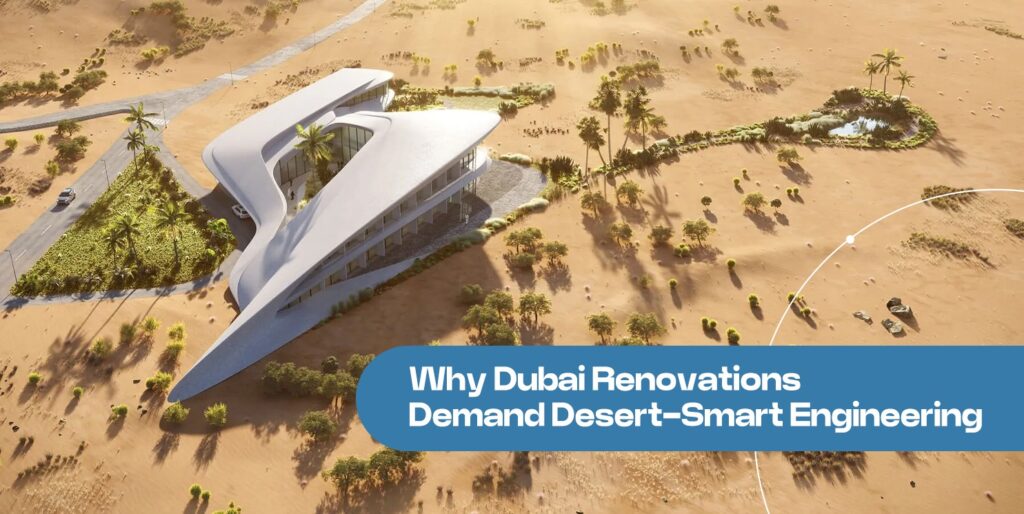
Dubai renovations often fail not from lack of aesthetic vision, but from fundamental misalignment between traditional materials and the Arabian Desert’s thermodynamic realities. Research shows urbanization has altered Dubai’s microclimate—increasing humidity 4% and temperatures 2°C since 2001.
With ambient temperatures exceeding 45°C, humidity peaking at 90%, and relentless sandstorms, Dubai’s climate creates a laboratory for material degradation. Successful renovations must prioritize “desert-smart” materials accounting for heat expansion, saline corrosion, moisture infiltration, and abrasive forces—or face premature failure requiring expensive corrections.
The UAE Landscape: Dubai’s Unique Climate Challenges
Dubai’s built environment faces a unique combination of extreme conditions that individually challenge construction materials—together, they create devastating compounding effects.
Temperature Extremes:
- Interiors at 22°C versus exterior façades reaching 60°C+
- Extreme diurnal swings creating internal material stresses
- Heat-induced expansion causing buckling, warping, tile-lifting
Humidity Fluctuations:
- Outdoor humidity peaking at 90%, indoor AC below 40%
- Moisture trapping condensation within wall cavities
- Invisible damage until structural or health issues emerge
Coastal Salinity:
- High chloride concentration in sea air
- Metal corrosion through pitting attacks
- Protective layers breached within months
Sandstorm Abrasion:
- Wind-driven sand acting as physical abrasive
- Paint stripping and glass pitting
- Continuous sealing integrity testing
The Critical Factors Causing Renovation Failure
Factor 1: Thermal Expansion and Contraction
Materials experience dimensional changes from extreme temperature differentials that compromise structural bonds if not properly managed.
Critical CTE Values (Coefficient of Thermal Expansion, $10^{-6}/°C$):
- Concrete: 7-12 (2.8-4.8mm expansion per 10m at 40°C differential)
- Aluminum: 21-24 (8.4-9.6mm expansion—severe deformation risk)
- PVC/Vinyl: 50-100 (20.0-40.0mm expansion—catastrophic warping)
- Porcelain Tile: 6-8 (2.4-3.2mm—adhesion failure/”pop-up”)
Failure Modes: Steel buckling, concrete cracking, vinyl warping, tile detachment from substrate.
Factor 2: Humidity and Vapor Barrier Failures
Dubai humidity creates dual threats—material degradation and mold growth. Outdoor humidity interacting with indoor AC traps condensation in wall cavities.
Thermal Bridging Crisis: Research shows 60% of mold cases in Dubai villas occur behind skirting boards where concrete slabs meet walls without thermal breaks. Conductive materials create surfaces dropping to 12°C below dew point, causing condensation and mold at humidity above 80%.
Factor 3: Saline Air Corrosion
Coastal properties face atmospheric salinity as primary catalyst for metal failure. Chloride ions facilitate pitting attacks breaching protective layers within months.
Material Requirements:
- Avoid Grade 304 stainless steel (rusts quickly)
- Minimum Grade 316/316L with 2-3% molybdenum
- Optimal Duplex 2205 for severe marine zones
- Mirror polished finish preventing salt accumulation
Factor 4: Thermal Efficiency Failures
Air conditioning accounts for 70% of peak electricity consumption. Renovations failing to optimize thermal envelope incur massive operational costs.
Advanced triple glazing achieves $0.5 \text{ W/m}^2\text{K}$ dramatically outperforming standard double-glazing.
The Remedies: Desert-Smart Solutions
Solution 1: Engineering Movement Joints
Movement joints accommodate dimensional changes preventing catastrophic failure. In Dubai’s climate, expansion joints should bound areas no larger than 40 square meters.
Implementation: High-performance EPDM-filled profiles, silicone sealants maintaining elasticity at 50°C, polymer-modified mortars with higher deformability.
Solution 2: Proper Vapor Barrier Installation
Exterior vapor barriers stop humid outdoor air infiltrating building cavities. Specialized products like 3M 3015NP perform in extreme heat (service temperatures to 116°C).
Thermal Break Integration: Insulating materials between conductive elements maintain interior surfaces above dew point, preventing condensation and mold while protecting structure and occupant health.
Solution 3: Marine-Grade Metal Specifications
Coastal Requirements:
- Minimum Grade 316L stainless steel
- Duplex 2205 for severe exposure
- Mirror polished finish
- Annual marine-grade coating, bi-weekly freshwater rinsing
Solution 4: Exterior Insulation Finishing Systems (EIFS)
EIFS represents gold standard for thermal performance, wrapping entire structure in continuous insulation blanket.
Performance: Eliminates thermal bridges, reduces annual cooling energy 47%, cuts labor costs 30-50%, provides design flexibility.
Solution 5: Climate-Intelligent Flooring
- SPC Flooring: 100% waterproof, dimensionally stable
- Engineered Wood: Cross-grain construction preventing warping
- Avoid Solid Hardwood: Shrinks in AC creating gaps
- Prioritize low-VOC paints/sealants for indoor air quality.
The Role of a Construction Partner
Dubai’s climate requires specialized engineering, not generic approaches. Professional partners provide material science expertise, regulatory navigation, hidden cost prevention, and lifecycle value focus.
Critical Services:
- Understanding CTE values and thermal expansion management
- Specifying marine-grade metals and proper vapor barriers
- Dubai Municipality licensing and master developer NOCs
- Al Safat green building compliance
Preventing lifecycle cost escalation (low-cost materials increase long-term costs 50%)
Wahat Babil: Your Desert-Smart Partner
At Wahat Babil, the Best Construction company in Dubai, Dubai’s climate demands specialized knowledge and systematic engineering. Our comprehensive services integrate climate science with proven building practices ensuring renovations withstand extreme conditions while delivering long-term value.
Our Complete Service Portfolio
- Interior Designing Services: Climate-intelligent material selection, thermal comfort optimization, humidity-resistant finishes, low-VOC specification, cultural integration (modern Majlis design).
- MEP Services (Mechanical, Electrical & Plumbing): Load analysis verifying capacity, HVAC optimization reducing cooling costs 30-60%, smart energy management, DEWA compliance, plumbing upgrades.
- Ceiling Works: Thermal break integration, moisture-resistant materials, proper insulation reducing AC loads, acoustic optimization.
- Home Renovation Services: Comprehensive transformations, phased renovation preventing decision fatigue, regulatory compliance, project management concept-through-completion.
- Villa Renovation Services: Large-scale residential upgrades, EIFS installation, marine-grade specifications for coastal properties, movement joint engineering.
- Bathroom Renovation: Proper waterproofing preventing hidden mold, vapor barrier installation, humidity-resistant materials, ventilation sizing for moisture management.
- Kitchen Renovation: Climate-resilient cabinetry (marine-grade plywood), engineered wood preventing warping, advanced ventilation, thermal-efficient appliance integration.
- Structural Villa Extension: Thermal expansion joint design, matching CTE values between new and existing construction, foundation engineering for sandy soil, Al Safat compliance.
- AC Services (Maintenance, Repair & Installation): System sizing for Dubai’s extreme loads, energy-efficient equipment, thermal envelope optimization reducing capacity requirements, preventive maintenance.
- Painting Works: Low-VOC/Zero-VOC formulations, UV-resistant exterior coatings, heat-reflective paints reducing surface temperatures, proper substrate preparation.
- Tiling Works: Movement joint placement every 40 square meters, polymer-modified mortars for thermal cycling, porcelain with appropriate CTE, proper adhesive for temperature differentials.
Building for Dubai's Reality
Dubai’s climate transformation—4% humidity increase, 2°C temperature rise since 2001—demands construction approaches specifically engineered for desert extremes. The difference between success and disaster lies in understanding thermal expansion, vapor permeability, PREN values, and U-value optimization.
Key Takeaways:
✓ Thermal expansion causes failure—engineer movement joints with compatible CTE values
✓ Humidity creates hidden mold—install vapor barriers and thermal breaks
✓ Coastal salinity demands marine-grade metals—minimum Grade 316L
✓ Thermal efficiency critical—EIFS and high-performance glazing reduce cooling costs 47%
✓ Climate-intelligent materials prevent escalation—upfront savings create 50% higher long-term costs
✓ Professional partners prevent expensive failures through specialized expertise
Wahat Babil brings systematic climate engineering to every renovation—from material specification through installation and long-term performance. We build for Dubai’s specific extreme reality, not temperate climate fantasies.
Ready to renovate with Desert-Smart Engineering?
Contact Wahat Babil to discuss how our climate-focused expertise transforms your property into a resilient asset built for Dubai’s demanding environment. Your investment deserves engineering working with the climate, not against it.